このページの内容は最新ではありません。最新版の英語を参照するには、ここをクリックします。
マルチオブジェクト トラッカー
さまざまなセンサーからの情報を融合するマルチオブジェクト トラッカーを作成できます。追跡されるオブジェクトに関する単一の仮説を維持するには、trackerGNN を使用します。追跡されるオブジェクトに関する複数の仮説を維持するには、trackerTOMHT を使用します。追跡されるオブジェクトに複数の可能性のある検出を割り当てるには、trackerJPDA を使用します。確率仮説密度 (PHD) 関数を使用して追跡されるオブジェクトを表すには、trackerPHD を使用します。グリッドベースの占有証拠アプローチを使用してオブジェクトを追跡するには、trackerGridRFS を使用します。追跡センサーまたはトラッカーによって生成されたトラックを融合し、分散型追跡システムを作成するには、trackFuser を使用します。
関数
assignauction | Assignment using auction global nearest neighbor |
assignjv | Jonker-Volgenant global nearest neighbor assignment algorithm |
assignkbest | Assignment using k-best global nearest neighbor |
assignkbestsd | K-best S-D solution that minimizes total cost of assignment |
assignmunkres | Munkres global nearest neighbor assignment algorithm |
assignsd | S-D assignment using Lagrangian relaxation |
assignTOMHT | Track-oriented multi-hypotheses tracking assignment |
jpdaEvents | Feasible joint events for trackerJPDA |
partitionDetections | Partition detections based on distance |
mergeDetections | Merge detections into clustered detections (R2021b 以降) |
trackerGNN | Multi-sensor, multi-object tracker using GNN assignment |
trackerJPDA | Joint probabilistic data association tracker |
trackerTOMHT | Multi-hypothesis, multi-sensor, multi-object tracker |
trackerPHD | Multi-sensor, multi-object PHD tracker |
trackerGridRFS | Grid-based multi-object tracker |
smootherJIPDA | Joint probabilistic data association smoother (R2023a 以降) |
dynamicEvidentialGridMap | Dynamic grid map output from trackerGridRFS |
objectDetection | 単一オブジェクトの検出のレポート |
objectDetectionDelay | Simulate out-of-sequence object detections (R2022a 以降) |
getTrackPositions | Returns updated track positions and position covariance matrix |
getTrackVelocities | Obtain updated track velocities and velocity covariance matrix |
clusterTrackBranches | Cluster track-oriented multi-hypothesis history |
compatibleTrackBranches | Formulate global hypotheses from clusters |
pruneTrackBranches | Prune track branches with low likelihood |
trackHistoryLogic | Confirm and delete tracks based on recent track history |
trackScoreLogic | Confirm and delete tracks based on track score |
trackBranchHistory | Track-oriented MHT branching and branch history |
trackingSensorConfiguration | Represent sensor configuration for tracking |
JIPDATracker | Task-oriented joint integrated probabilistic data association tracker (R2024b 以降) |
multiSensorTargetTracker | Task-oriented tracker based on target and sensor specifications (R2024b 以降) |
trackerTargetSpec | Target specification for multi-target multi-sensor task-oriented tracker (R2024b 以降) |
trackerSensorSpec | Sensor specification for multi-target multi-sensor specification-based tracker (R2024b 以降) |
hasTrackerInput | Determine whether tracker needs additional input for target specification (R2024b 以降) |
dataFormat | Structure for data format required by task-oriented tracker (R2024b 以降) |
CustomSensor | Custom sensor specification (R2025a 以降) |
CustomTarget | Custom target specification (R2025a 以降) |
GeneralAviation | Target specification for general aviation aircraft (R2024b 以降) |
Helicopter | Target specification for helicopter (R2024b 以降) |
HighwayCar | Target specification for car driving on highway (R2024b 以降) |
HighwayTruck | Target specification for truck driving on highway (R2024b 以降) |
PassengerAircraft | Target specification for passenger aircraft (R2024b 以降) |
ManeuveringAircraft | Target specification for maneuvering aircraft (R2025a 以降) |
AutomotiveCameraBoxes | Sensor specification for vehicle-mounted camera that reports images with 2-D bounding boxes (R2024b 以降) |
AutomotiveLidarBoxes | Sensor specification for vehicle-mounted lidar that reports point cloud clustered in 3-D bounding boxes (R2024b 以降) |
AutomotiveRadarClusteredPoints | Sensor specification for vehicle-mounted radar that has low to medium resolution (R2024b 以降) |
AerospaceESMRadar | Sensor specification for direction-finding radar (R2024b 以降) |
AerospaceMonostaticRadar | Sensor specification for monostatic radar (R2024b 以降) |
AerospaceBistaticRadar | Sensor specification for bistatic radar (R2025a 以降) |
AerospaceAngleOnlyIR | Sensor specification for infrared sensor that reports angle-only measurements (R2024b 以降) |
targetStateTransitionModel | State transition model for custom target specification (R2025a 以降) |
targetSurvivalModel | Survival model for custom target specification (R2025a 以降) |
sensorBirthModel | Birth model for custom sensor specification (R2025a 以降) |
sensorMeasurementModel | Measurement model for custom sensor specification (R2025a 以降) |
sensorClutterModel | Clutter model for custom sensor specification (R2025a 以降) |
sensorDetectabilityModel | Detectability model for custom sensor specification (R2025a 以降) |
UniformPoissonModel | Uniform Poisson birth model (R2025a 以降) |
NonUniformPoissonModel | Nonuniform Poisson birth model (R2025a 以降) |
UniformPoissonModel | Uniform Poisson clutter model (R2025a 以降) |
NonUniformPoissonModel | Nonuniform Poisson clutter model (R2025a 以降) |
FieldOfViewModel | Field of view detectability model (R2025a 以降) |
FieldOfViewAndRangeRateModel | Field of view and range rate limits detectability model (R2025a 以降) |
CompositeFieldOfViewModel | Composite field of view detectability model (R2025a 以降) |
UniformDetectabilityModel | Uniform detectability model (R2025a 以降) |
RangeModel | Range measurement model (R2025a 以降) |
RangeAndRangeRateModel | Range and range rate measurement model (R2025a 以降) |
PositionModel | Position measurement model (R2025a 以降) |
PositionVelocityModel | Position and velocity measurement model (R2025a 以降) |
AzimuthElevationRangeAndRangeRateModel | Azimuth, elevation, range, and range rate measurement model (R2025a 以降) |
AzimuthElevationRangeModel | Azimuth and elevation measurement model (R2025a 以降) |
AzimuthElevationModel | Azimuth and elevation measurement model (R2025a 以降) |
AzimuthRangeAndRangeRateModel | Azimuth, range, and range rate measurement model (R2025a 以降) |
AzimuthRangeModel | Azimuth and range measurement model (R2025a 以降) |
AzimuthModel | Azimuth measurement model (R2025a 以降) |
UniformSurvivalRateModel | Uniform survival rate survival model (R2025a 以降) |
RegionOfInterestSurvivalRateModel | Region of interest (ROI) survival model (R2025a 以降) |
ConstantVelocityModel | Constant velocity state transition model (R2025a 以降) |
ConstantAccelerationModel | Constant acceleration state transition model (R2025a 以降) |
ConstantTurnRateModel | Constant turn-rate state transition model (R2025a 以降) |
SingerAccelerationModel | Singer acceleration state transition model (R2025a 以降) |
InteractingMultipleModel | Interacting multiple model (IMM) state transition model (R2025a 以降) |
trackFuser | Single-hypothesis track-to-track fuser |
trackingArchitecture | Tracking system-of-system architecture |
staticDetectionFuser | Static fusion of synchronous sensor detections |
objectTrack | Single object track report |
fusecovint | Covariance fusion using covariance intersection |
fusecovunion | Covariance fusion using covariance union |
fusexcov | Covariance fusion using cross-covariance |
fuserSourceConfiguration | Configuration of source used with track fuser |
triangulateLOS | Triangulate multiple line-of-sight detections |
ブロック
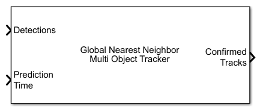
| Global Nearest Neighbor Multi Object Tracker | Multi-sensor, multi-object tracker using GNN assignment |
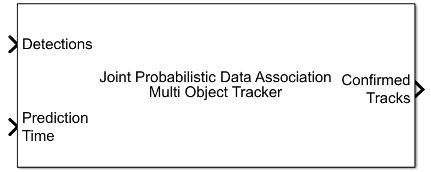
| Joint Probabilistic Data Association Multi Object Tracker | Joint probabilistic data association tracker |
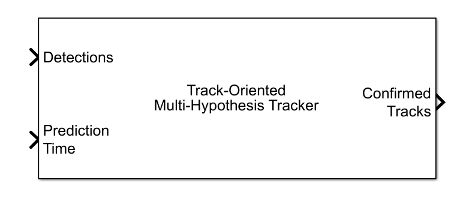
| Track-Oriented Multi-Hypothesis Tracker | Track-Oriented Multi-Hypothesis Tracker |
| Probability Hypothesis Density (PHD) Tracker | Multi-sensor, multi-object PHD tracker |
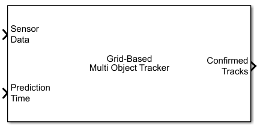
| Grid-Based Multi Object Tracker | Grid-based multi-object tracker using random finite set approach (R2021b 以降) |
| Track-To-Track Fuser | Track-to-Track Fusion |
| Detection Concatenation | 異なるセンサーからの検出レポートの結合 |
| Track Concatenation | Concatenate tracks |
トピック
- Introduction to Multiple Target Tracking
Introduction to assignment-based multiple target trackers.
- Introduction to Assignment Methods in Tracking Systems
Introduce 2-D and S-D assignment problems in tracking systems.
- トラック間フュージョンの概要
トラック フューザーを使用したトラック間フュージョン アーキテクチャ。
- Multiple Extended Object Tracking
Introduction to methods and examples of multiple extended object tracking in the toolbox.
- Convert Detections to objectDetection Format
These examples show how to convert actual detections in the native format of the sensor into
objectDetectionobjects. - Introduction to Using the Global Nearest Neighbor Tracker
This example shows how to configure and use the global nearest neighbor (GNN) tracker.
- Introduction to Track Logic
This example shows how to define and use confirmation and deletion logic that are based on history or score.
- Introduction to PHD Filter
This example introduces the principles behind the probability hypothesis density (PHD) filter and how it can be used to estimate the number and states of multiple objects in a scene. (R2023b 以降)
- Generate Code with Strict Single-Precision and Non-Dynamic Memory Allocation
Introduce functions, objects, and blocks that support strict single-precision and non-dynamic memory allocation code generation in Sensor Fusion and Tracking Toolbox™.
注目の例
Tracking Closely Spaced Targets Under Ambiguity
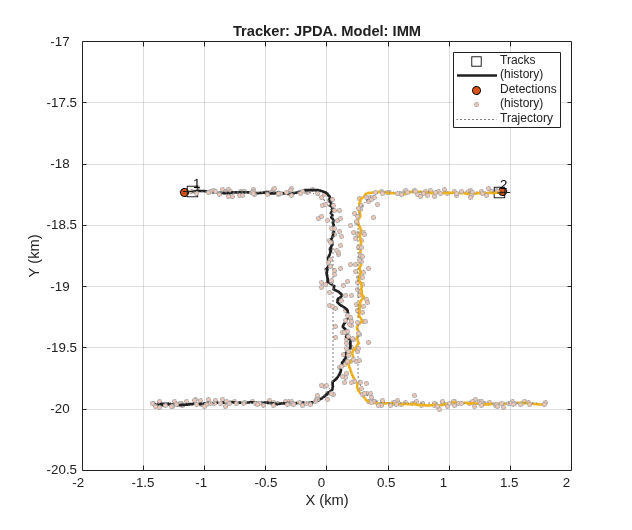
Track objects when the association of sensor detections to tracks is ambiguous. In this example, you use a single-hypothesis tracker, a multiple-hypothesis tracker, and a probabilistic data association tracker to compare how the trackers handle this ambiguity. To track, the maneuvering targets better, you estimate the motion of the targets by using various models.
Introduction to Class Fusion and Classification-Aided Tracking
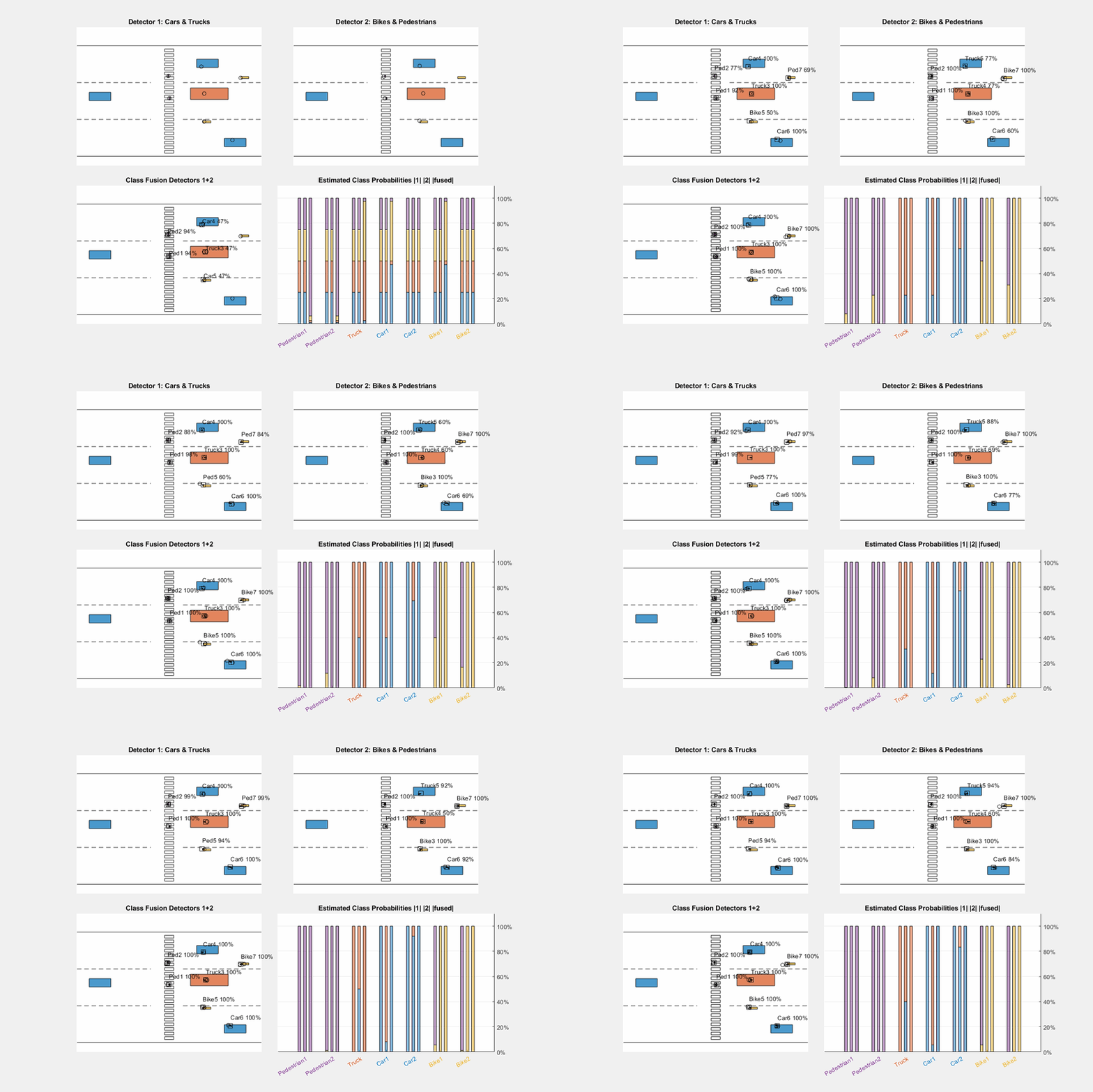
Perform class fusion using multi-object tracker.
- R2022b 以降
- ライブ スクリプトを開く
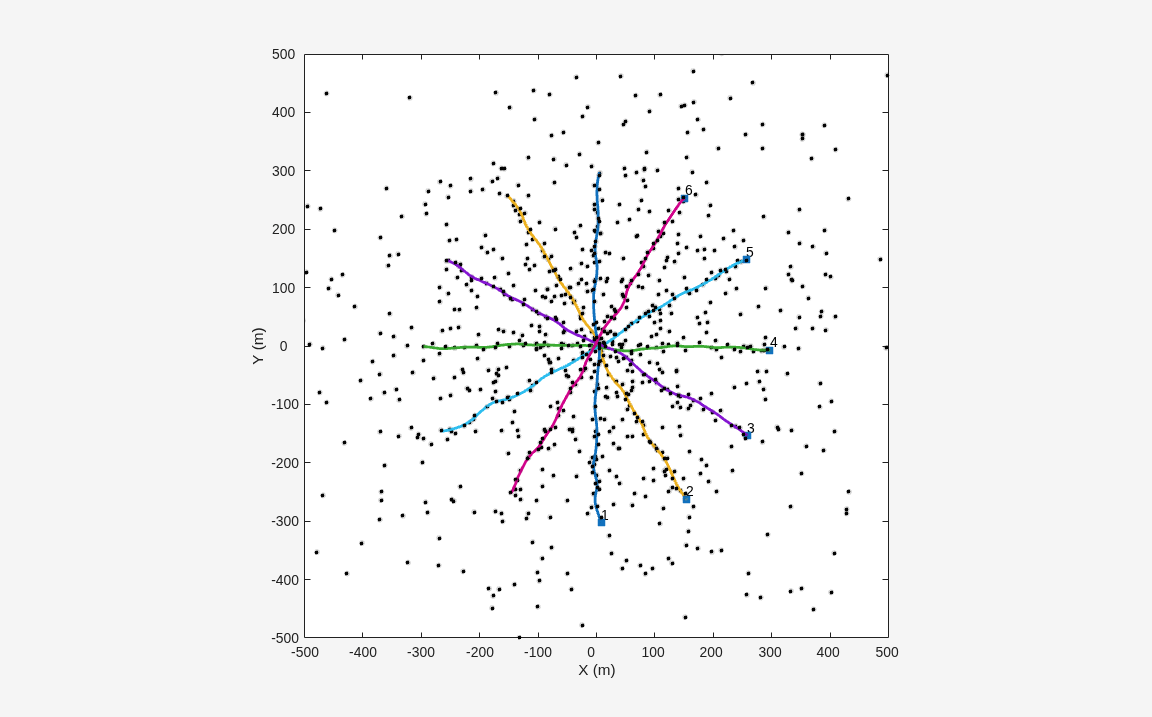
Tracking a Flock of Birds
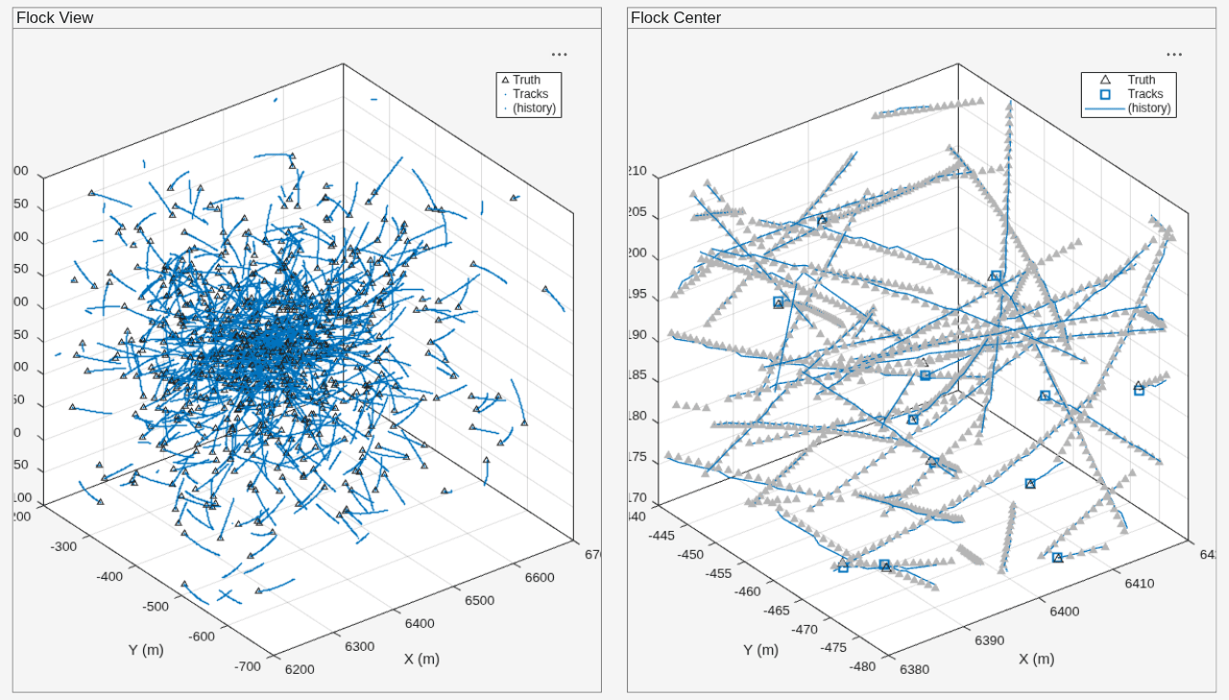
Track a large number of objects. A large flock of birds is generated and a global nearest neighbor multi-object tracker, trackerGNN, is used to estimate the motion of every bird in the flock.
Define and Test Tracking Architectures for System-of-Systems
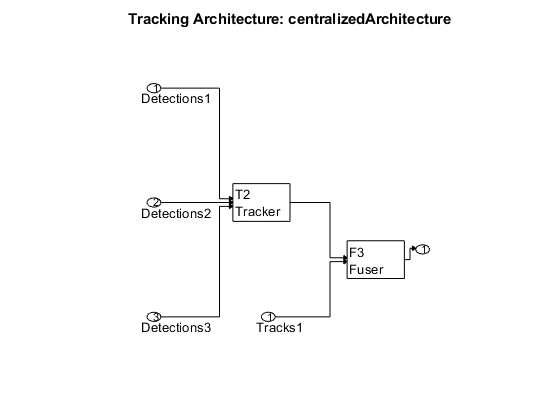
Define the tracking architecture of a system-of-systems that includes multiple detection-level multi-object trackers and track-level fusion algorithms. You can use the tracking architectures to compare different tracking system designs and find the best solution for your system.
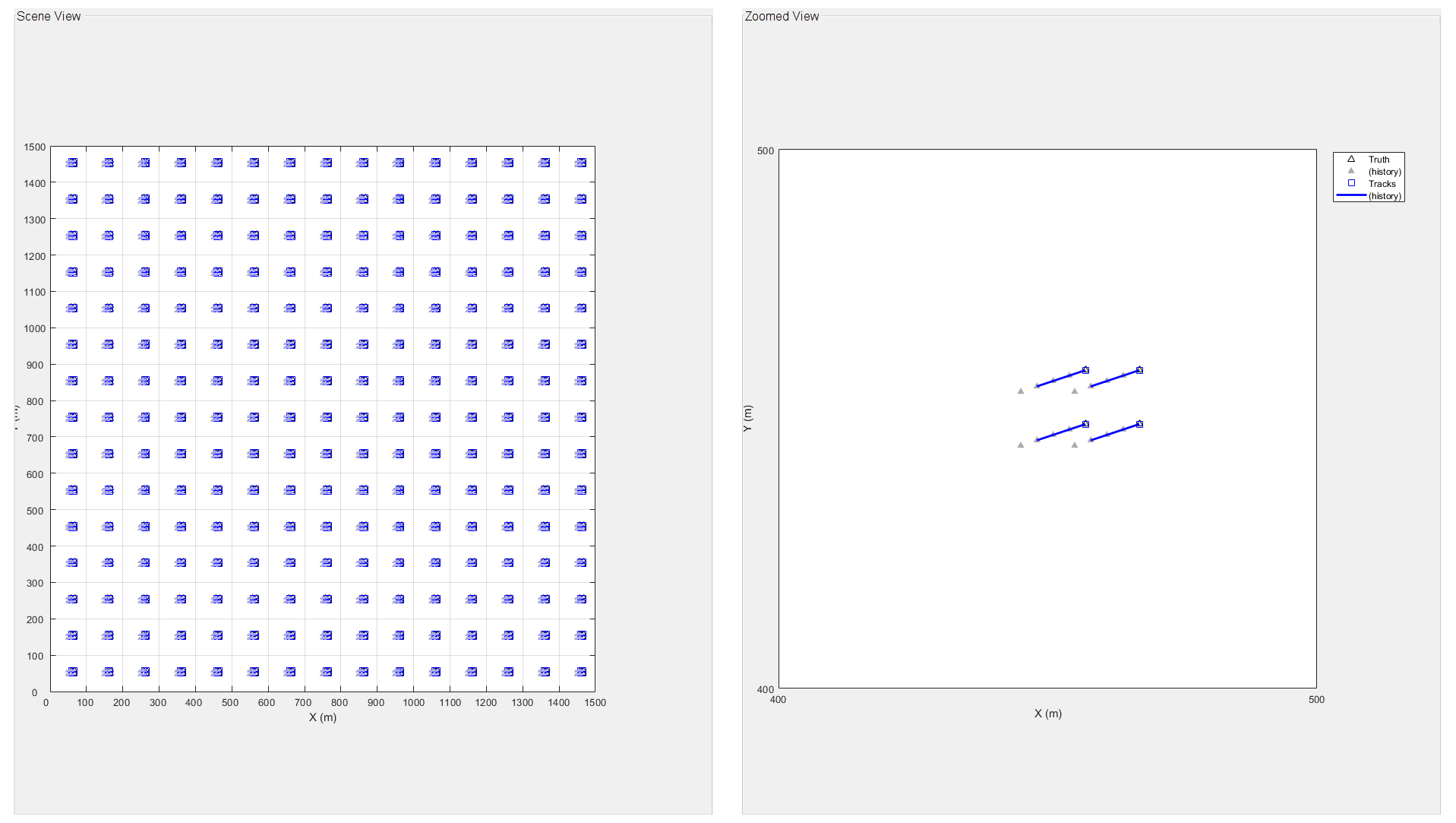
How to Efficiently Track Large Numbers of Objects
Use the trackerGNN to track large numbers of targets. Similar techniques can be applied to the trackerJPDA and trackerTOMHT as well.
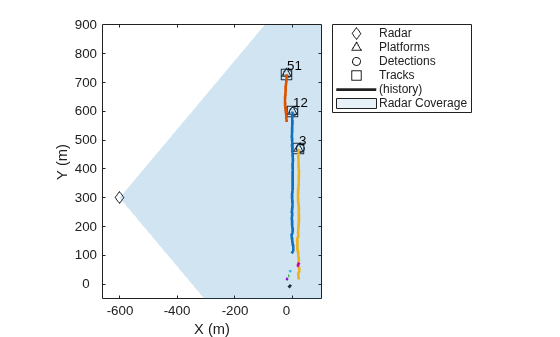
Tuning a Multi-Object Tracker
Tune and run a tracker to track multiple objects in the scene. The example explains and demonstrates the importance of key properties of the trackers in the Sensor Fusion and Tracking Toolbox™.
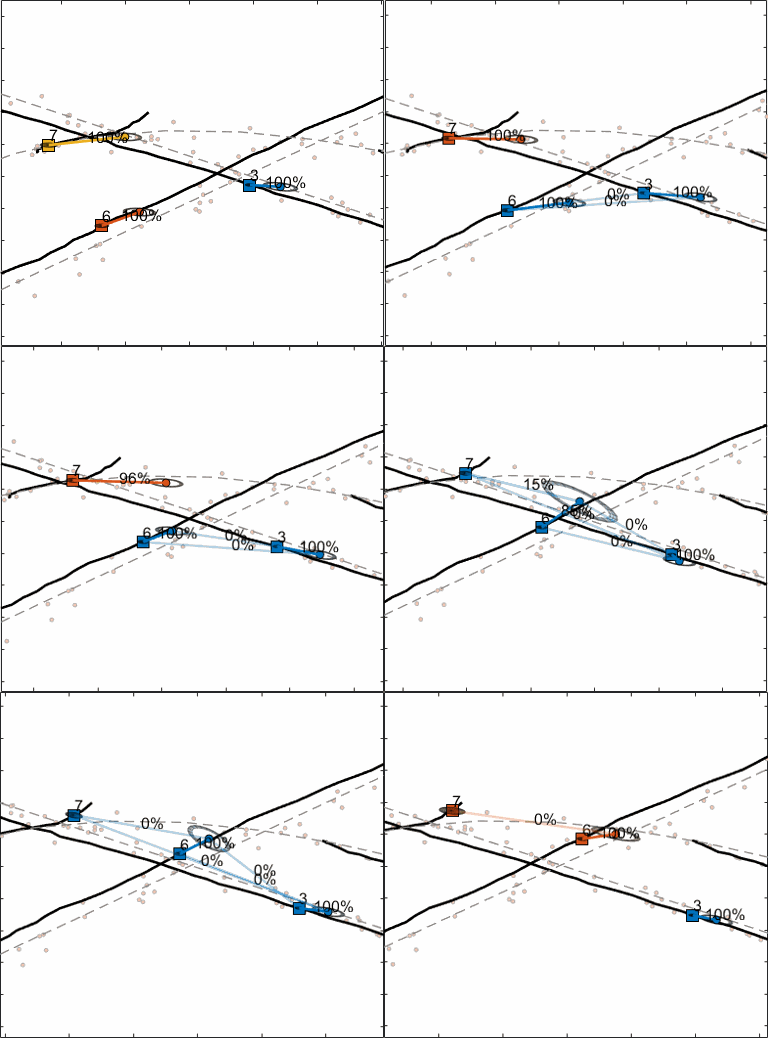
Analyze Track and Detection Association Using Analysis Info
Use tracker analysis information to analyze detection and track association in tracking process.
- R2022b 以降
- ライブ スクリプトを開く
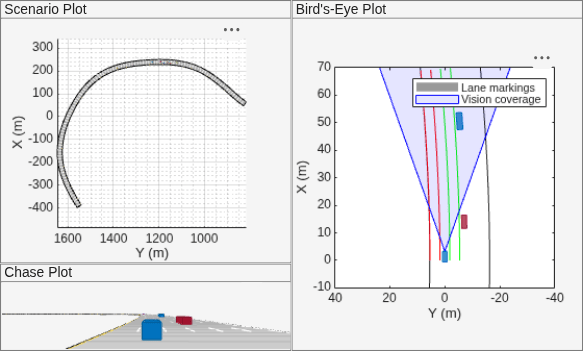
Track Multiple Lane Boundaries with a Global Nearest Neighbor Tracker
Design and test a multiple lane tracking algorithm. The algorithm is tested in a driving scenario with probabilistic lane detections.
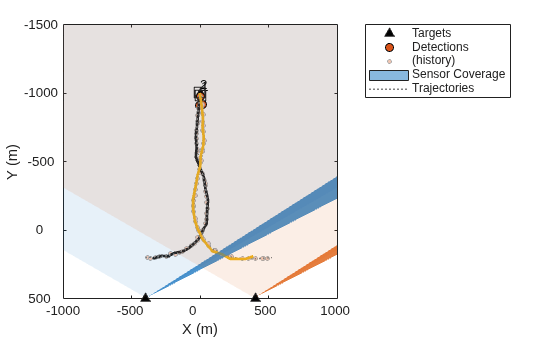
Handle Out-of-Sequence Measurements in Multisensor Tracking Systems
Handle out-of-sequence measurements (OOSM) in a multisensor tracking system. The example compares tracking results when OOSM are present using various handling techniques. For more information about OOSM handling techniques see Handle Out-of-Sequence Measurements with Filter Retrodiction example.
- R2021b 以降
- ライブ スクリプトを開く
Introduction to JIPDA Smoothing
Introduce joint integrated probabilistic data association multi-object smoothing algorithm and its applications.
- R2023a 以降
- ライブ スクリプトを開く
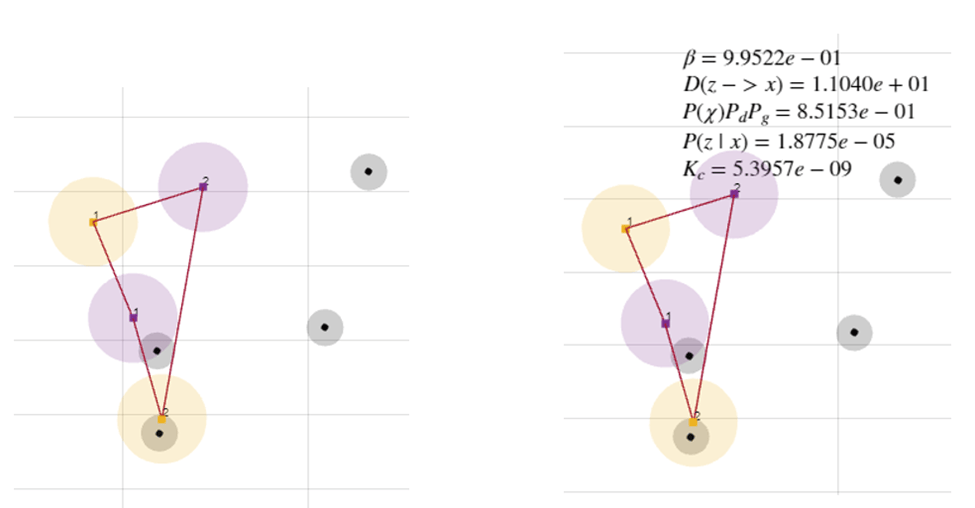
Understand and Analyze JIPDA Smoother Algorithm
Illustrate workflow of joint integrated probabilistic data association multi-object smoother algorithm.
- R2023a 以降
- ライブ スクリプトを開く
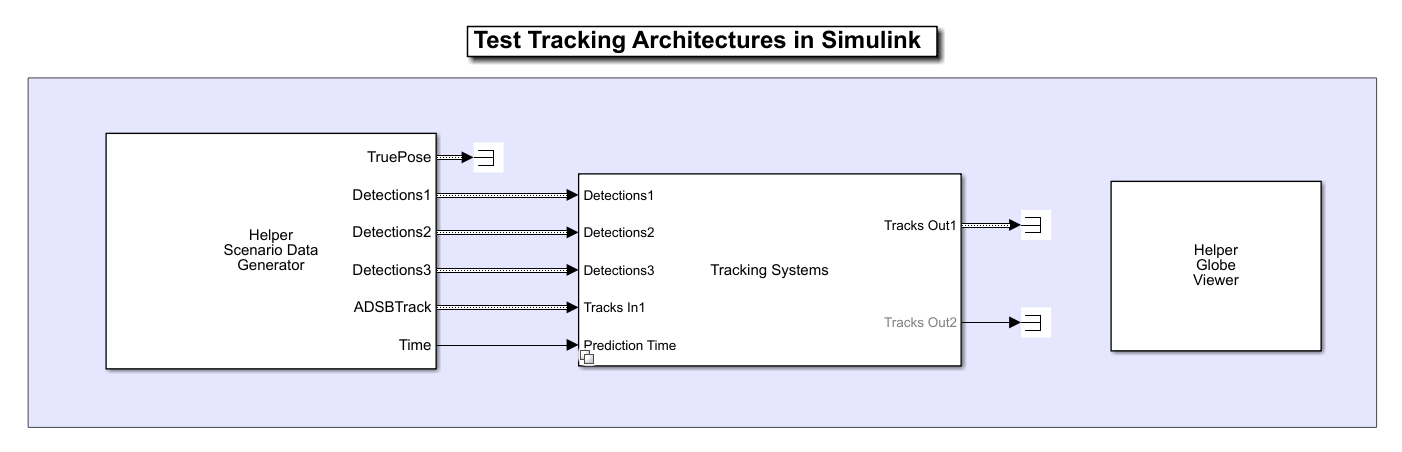
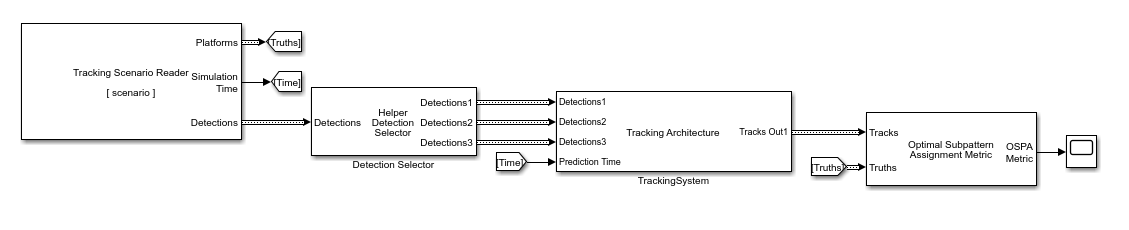
Define and Test Tracking Architectures for System-of-Systems in Simulink
Define architectures for a tracking system-of-systems in MATLAB® and export them to a Simulink® model. You compare various tracking system designs that includes multiple detection-level multi-object trackers and track fusers in Simulink. You use Simulink Variant systems to realize different architecture solutions for your system. This example closely follows the Define and Test Tracking Architectures for System-of-Systems MATLAB example.
- R2022a 以降
- ライブ スクリプトを開く
Export trackingArchitecture to Simulink
Define a trackingArchitecture object and export it to Simulink®.

- R2022a 以降
- ライブ スクリプトを開く
Track Simulated Vehicles Using GNN and JPDA Trackers in Simulink
Configure and utilize GNN and JPDA trackers in a simulated highway scenario in Simulink® with Sensor Fusion and Tracking Toolbox™. It closely follows the Simulink で合成レーダーおよびビジョン データを使用したセンサー フュージョン (Automated Driving Toolbox). A main benefit of modeling the system in Simulink is the simplicity of performing "what-if" analysis and choosing a tracker that results in the best performance based on the requirements.
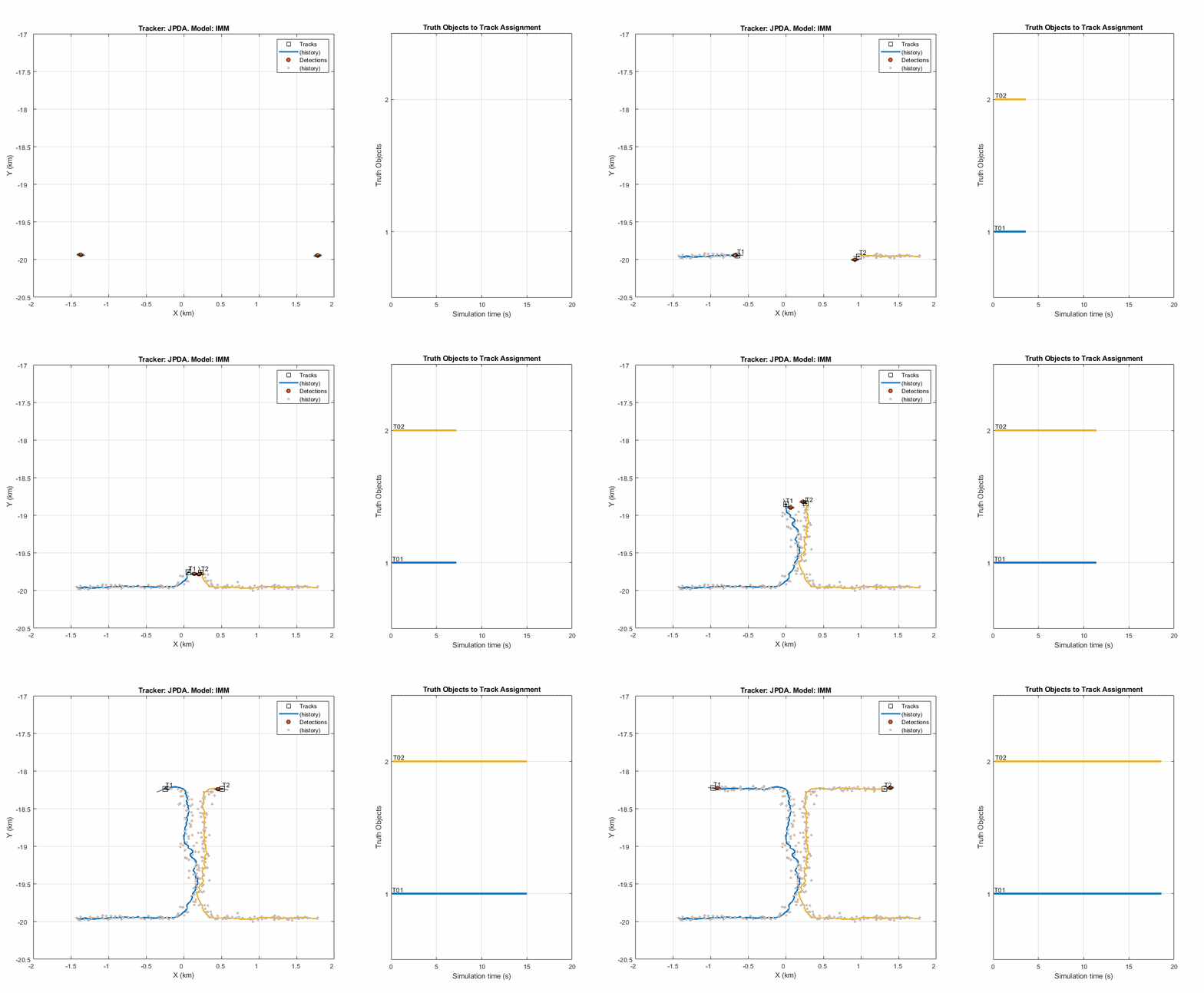
Track Closely Spaced Targets Under Ambiguity in Simulink
Track objects in Simulink® with Sensor Fusion and Tracking Toolbox™ when the association of sensor detections to tracks is ambiguous. It closely follows the Tracking Closely Spaced Targets Under Ambiguity MATLAB® example.
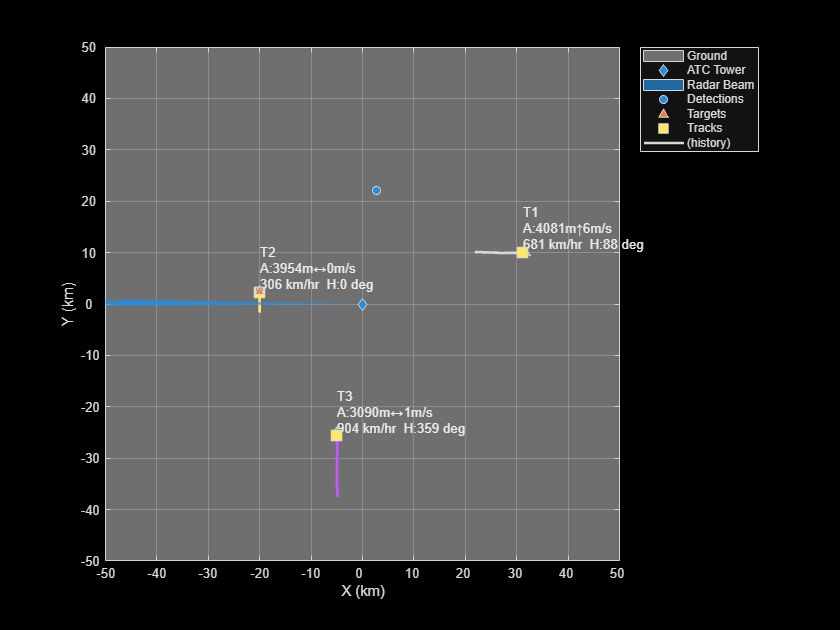
How to Generate C Code for a Tracker
Generate C code for a MATLAB function that processes detections and outputs tracks. The function contains a trackerGNN, but any tracker can be used instead.
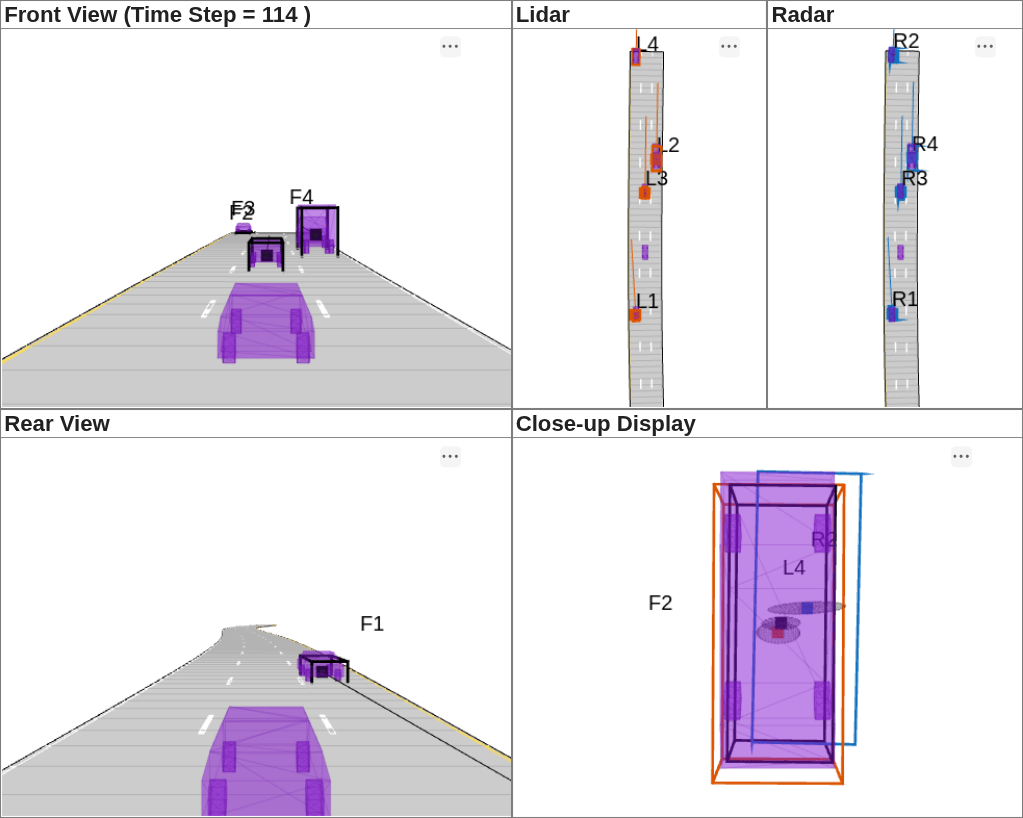
Generate Code for a Track Fuser with Heterogeneous Source Tracks
Generate code for a track-level fusion algorithm in a scenario where the tracks originate from heterogeneous sources with different state definitions. This example is based on the Track-Level Fusion of Radar and Lidar Data example, in which the state spaces of the tracks generated from lidar and radar sources are different.
MATLAB Command
You clicked a link that corresponds to this MATLAB command:
Run the command by entering it in the MATLAB Command Window. Web browsers do not support MATLAB commands.
Web サイトの選択
Web サイトを選択すると、翻訳されたコンテンツにアクセスし、地域のイベントやサービスを確認できます。現在の位置情報に基づき、次のサイトの選択を推奨します:
また、以下のリストから Web サイトを選択することもできます。
最適なサイトパフォーマンスの取得方法
中国のサイト (中国語または英語) を選択することで、最適なサイトパフォーマンスが得られます。その他の国の MathWorks のサイトは、お客様の地域からのアクセスが最適化されていません。
南北アメリカ
- América Latina (Español)
- Canada (English)
- United States (English)
ヨーロッパ
- Belgium (English)
- Denmark (English)
- Deutschland (Deutsch)
- España (Español)
- Finland (English)
- France (Français)
- Ireland (English)
- Italia (Italiano)
- Luxembourg (English)
- Netherlands (English)
- Norway (English)
- Österreich (Deutsch)
- Portugal (English)
- Sweden (English)
- Switzerland
- United Kingdom (English)