このページの内容は最新ではありません。最新版の英語を参照するには、ここをクリックします。
検出
R2026aターゲット検出、CFAR、2-D CFAR、ROC 曲線、ソナー方程式
Phased Array System Toolbox™ には、整合フィルター処理、1 次元または 2 次元での定偽警報率 (CFAR) 検出、ストレッチ処理パルス圧縮、およびコヒーレント/非コヒーレント パルス積分を実行するための System object と Simulink® ブロックが含まれています。ユーティリティ関数を使用すると、さまざまな S/N 比 (SNR) レベルまたは偽警報の確率に対する受信者動作特性 (ROC) 曲線を計算して可視化できます。一連の関数やアプリを使用することで、レーダー方程式を使用してレーダー解析を実行できます。たとえば、受信 SNR や最大ターゲット検出レンジを推定できます。ソナー方程式についても同様の機能セットが提供されます。ブレイク チャートを使用することで、レーダー カバレッジを可視化できます。
オブジェクト
phased.AlphaBetaFilter | Alpha-beta filter for object tracking |
phased.CFARDetector | Constant false alarm rate (CFAR) detector |
phased.CFARDetector2D | Two-dimensional CFAR detector |
phased.GLRTDetector | Generalized likelihood ratio detector (R2023b 以降) |
phased.LRTDetector | Likelihood ratio test detector (R2023b 以降) |
phased.MatchedFilter | Matched filter |
phased.StretchProcessor | Stretch processor for linear FM waveform |
phased.TimeVaryingGain | Time varying gain control |
ブロック
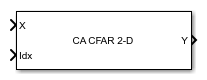 | 2-D CFAR Detector | Two-dimensional constant false alarm rate (CFAR) detector |
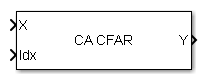 | CFAR Detector | Constant false alarm rate (CFAR) detector |
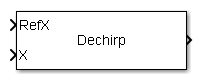 | Dechirp Mixer | Dechirping operation on input signal |
 | GLRT Detector | Perform generalized likelihood ratio test detection (R2023b 以降) |
 | LRT Detector | Likelihood ratio test detector (R2023b 以降) |
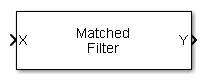 | Matched Filter | Matched filter |
 | Pulse Integrator | Coherent or noncoherent pulse integration |
 | Stretch Processor | Stretch processor for linear FM waveforms |
 | Time Varying Gain | Time varying gain (TVG) control |
 | Whitening Matrix | Whitening transformation of covariance matrix (R2026a 以降) |
関数
アプリ
| ソナー方程式計算機 | Estimate maximum range, SNR, transmission loss and source level of a sonar system |
| センサー アレイ アナライザー | 線形、平面、3D、および任意のセンサー アレイのビーム パターンとパフォーマンス特性の解析 |
トピック
検出と推定
- Neyman-Pearson Hypothesis Testing
In phased-array applications, you sometimes need to decide between two competing hypotheses to determine the reality underlying the data the array receives. - Constant False-Alarm Rate (CFAR) Detectors
CFAR detectors apply the Neyman-Pearson criterion to target detection. The detectors estimate noise statistics from data. - Receiver Operating Characteristics
Receiver operating characteristic (ROC) curves describe a detector’s performance by relating probability of false alarm to probability of detection. - 整合フィルター処理
整合フィルター処理により、SNR が向上し、検出が改善されます。 - Stretch Processing
Stretch processing, also known as deramping or dechirping, is an alternative to matched filtering. - FMCW Range Estimation
FMCW range estimation dechirps the received signal, extracts beat frequencies, and computes the target range. - レンジ-ドップラー応答
レンジ-ドップラー処理を実行し、レンジ-ドップラー マップを可視化する。
フェーズド アレイ規則
- Standards and Conventions
This section introduces the concept of baseband signals and defines the local and global coordinate systems used in the toolbox. - Units of Measure and Physical Constants
Phased Array System Toolbox uses the International System of Units (SI).
ソナー方程式
- Sonar Equation
The sonar equation is used in underwater signal processing to relate received signal power to transmitted signal power for one-way or two-way sound propagation. - Doppler Effect for Sound
The Doppler effect is the change in the observed frequency of a source due to the motion of either the source or receiver or both.

