rlDQNAgent
R2026bDeep Q-network (DQN) reinforcement learning agent
Description
The deep Q-network (DQN) algorithm is an off-policy reinforcement learning method for environments with a discrete action space. A DQN agent trains a Q-value function critic to estimate the value of the optimal policy, while following an epsilon-greedy policy based on the value estimated by the critic. DQN is a variant of Q-learning that features a target critic and an experience buffer. The DQN agent supports offline training (training from saved data, without an environment).
For more information, Deep Q-Network (DQN) Agent. For more information on the different types of reinforcement learning agents, see Reinforcement Learning Agents.
Creation
Syntax
Description
Create Default Agent from Observation and Action Specifications
agent = rlDQNAgent(observationInfo,actionInfo)
agent = rlDQNAgent(observationInfo,actionInfo,initOpts)initOpts object. For more information on the initialization
options, see rlAgentInitializationOptions.
Create Agent from Critic
agent = rlDQNAgent(critic)
Specify Agent Options
agent = rlDQNAgent(critic,agentOptions)AgentOptions
property to the agentOptions input argument. Use this syntax after
any of the input arguments in the previous syntaxes..
Input Arguments
Properties
Object Functions
train | Train reinforcement learning agents within a specified environment |
sim | Simulate trained reinforcement learning agents within specified environment |
getAction | Obtain action from agent, actor, or policy object given environment observations |
getCritic | Extract critic from reinforcement learning agent |
setCritic | Set critic of reinforcement learning agent |
generatePolicyFunction | Generate MATLAB function that evaluates policy of an agent or policy object |
Examples
Create an environment with a discrete action space, and obtain its observation and action specifications.
For this example, load the environment used in the example Create DQN Agent Using Deep Network Designer and Train Using Image Observations. This environment has two observation channels: one carrying a 50-by-50 grayscale image and the other carrying a scalar (the angular velocity of the pendulum). The action is a scalar with five possible elements (a torque of either -2, -1, 0, 1, or 2 Nm applied to a swinging pole).
% Load predefined environment
env = rlPredefinedEnv("SimplePendulumWithImage-Discrete");

% Obtain observation and action specifications
obsInfo = getObservationInfo(env);
actInfo = getActionInfo(env);
The agent creation function initializes the actor and critic networks randomly. You can ensure reproducibility by fixing the seed of the random generator.
rng(0,"twister")Create a deep Q-network agent from the environment observation and action specifications.
agent = rlDQNAgent(obsInfo,actInfo);
To check your agent, use the getAction function to return the action from a batch of 10 random observations.
robs1 = rand([obsInfo(1).Dimension 10]);
robs2 = rand([obsInfo(2).Dimension 10]);
act = getAction(agent,{robs1,robs2});
Display the seventh element in the batch.
act{1}(7)ans = -2
You can now test and train the agent within the environment.
Create an environment with a discrete action space, and obtain its observation and action specifications.
For this example, load the environment used in the example Create DQN Agent Using Deep Network Designer and Train Using Image Observations. This environment has two observation channels: one carrying a 50-by-50 grayscale image and the other carrying a scalar (the angular velocity of the pendulum). The action is a scalar with five possible elements (a torque of either -2, -1, 0, 1, or 2 Nm applied to a swinging pole).
% Load predefined environment.
env = rlPredefinedEnv("SimplePendulumWithImage-Discrete");

% Obtain observation and action specifications.
obsInfo = getObservationInfo(env);
actInfo = getActionInfo(env);
Create an agent initialization option object, specifying that each hidden fully connected layer in the network must have 128 neurons (instead of the default number, 256).
initOpts = rlAgentInitializationOptions(NumHiddenUnit=128);
The agent creation function initializes the actor and critic networks randomly. To reproduce the results of this section, specify the seed and algorithm used for random number generation.
rng(0,"twister")Create a default deep Q-network agent from the environment observation and action specifications. Pass the initialization options object as the third argument.
agent = rlDQNAgent(obsInfo,actInfo,initOpts);
Extract the deep neural network from both the critic.
criticNet = getModel(getCritic(agent));
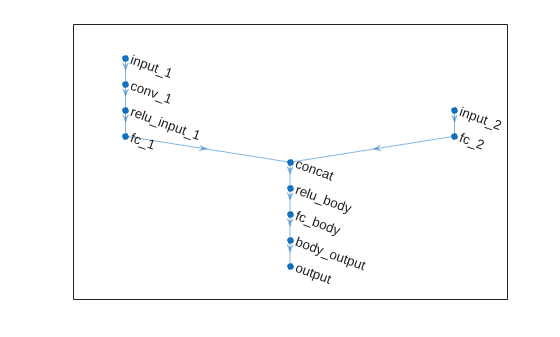
To verify that each hidden fully connected layer has 128 neurons, you can display the layers on the MATLAB® command window,
criticNet.Layers
or visualize the structure interactively using analyzeNetwork.
analyzeNetwork(criticNet)
Plot the critic network.
plot(criticNet)
To check your agent, use the getAction function to return the actions from a batch of 10 random observations.
obs1 = rand([obsInfo(1).Dimension 10]);
obs2 = rand([obsInfo(2).Dimension 10]);
act = getAction(agent,{obs1,obs2});
Display the seventh element in the batch.
act{1}(7)ans = -1
You can now test and train the agent within the environment.
Create an environment object and obtain its observation and action specifications. For this example load the predefined environment used for the Train Default DQN Agent to Balance Discrete Cart-Pole example. This environment has a continuous four-dimensional observation space (the positions and velocities of both cart and pole) and a discrete one-dimensional action space consisting on the application of two possible forces, -10N or 10N.
Create the predefined environment.
env = rlPredefinedEnv("CartPole-Discrete");Get the observation and action specification objects.
obsInfo = getObservationInfo(env);
actInfo = getActionInfo(env);
A DQN agent approximates the long-term reward, given observations and actions, using a parameterized Q-value function critic.
Because DQN agents have a discrete action space, you have the option to create a vector (that is, a multi-output) Q-value function critic, which is generally more efficient than a comparable single-output critic. A vector Q-value function is a mapping from an environment observation to a vector in which each element represents the expected discounted cumulative long-term reward when an agent starts from the state corresponding to the given observation and executes the action corresponding to the element number (and follows a given policy afterward).
To model the Q-value function within the critic, use a deep neural network. The network must have one input layer (which receives the content of the observation channel, as specified by obsInfo) and one output layer (which returns the vector of values for all the possible actions).
Define the network as an array of layer objects, and get the dimensions of the observation space (that is, prod(obsInfo.Dimension)) and the number of possible actions (that is, numel(actInfo.Elements)) directly from the environment specification objects.
dnn = [
    featureInputLayer(prod(obsInfo.Dimension))
    fullyConnectedLayer(24)
    reluLayer
    fullyConnectedLayer(24)
    reluLayer
    fullyConnectedLayer(numel(actInfo.Elements))
    ];
Convert the network to a dlnetwork object ad display the number of weights.
dnn = dlnetwork(dnn);
summary(dnn)
   Initialized: true

   Number of learnables: 770

   Inputs:
      1   'input'   4 features
Create the critic using rlVectorQValueFunction, the network dnn as well as the observation and action specifications.
critic = rlVectorQValueFunction(dnn,obsInfo,actInfo);
Check that the critic works with a random observation input.
getValue(critic,{rand(obsInfo.Dimension)})ans = 2×1 single column vector
-0.0361
0.0913
Create the DQN agent using the critic.
agent = rlDQNAgent(critic)
agent =
  rlDQNAgent with properties:

        ExperienceBuffer: [1×1 rl.replay.rlReplayMemory]
            AgentOptions: [1×1 rl.option.rlDQNAgentOptions]
    UseExplorationPolicy: 0
         ObservationInfo: [1×1 rl.util.rlNumericSpec]
              ActionInfo: [1×1 rl.util.rlFiniteSetSpec]
              SampleTime: 1
       UseGPUForLearning: "off"
         IntrinsicReward: []
Specify agent options, including training options for the critic.
agent.AgentOptions.UseDoubleDQN=false;
agent.AgentOptions.TargetUpdateMethod="periodic";
agent.AgentOptions.TargetUpdateFrequency=4;
agent.AgentOptions.ExperienceBufferLength=100000;
agent.AgentOptions.DiscountFactor=0.99;
agent.AgentOptions.MiniBatchSize=256;

agent.AgentOptions.CriticOptimizerOptions.LearnRate=1e-2;
agent.AgentOptions.CriticOptimizerOptions.GradientThreshold=1;
To check your agent, use the getAction function to return the action from a random observation.
getAction(agent,{rand(obsInfo.Dimension)})ans = 1×1 cell array
{[10]}
You can now test and train the agent within the environment.
Create an environment object and obtain its observation and action specifications. For this example load the predefined environment used for the Train Default DQN Agent to Balance Discrete Cart-Pole example. This environment has a continuous four-dimensional observation space (the positions and velocities of both cart and pole) and a discrete one-dimensional action space consisting on the application of two possible forces, -10 N or 10 N.
Create the predefined environment.
env = rlPredefinedEnv("CartPole-Discrete");Get the observation and action specification objects.
obsInfo = getObservationInfo(env);
actInfo = getActionInfo(env);
For DQN agents, you can use multi-output Q-value function critics, which are generally more efficient than comparable single-output critics. However, for this example, create a single-output Q-value function critic instead.
A Q-value function critic takes the current observation and an action as inputs and returns a single scalar as output (the estimated discounted cumulative long-term reward for taking the action from the state corresponding to the current observation, and following the policy thereafter).
To model the parameterized Q-value function within the critic, use a neural network with two input layers (one for the observation channel, as specified by obsInfo, and the other for the action channel, as specified by actInfo) and one output layer (which returns the scalar value).
Note that prod(obsInfo.Dimension) and prod(actInfo.Dimension) return the number of dimensions of the observation and action spaces, respectively, regardless of whether they are arranged as row vectors, column vectors, or matrices.
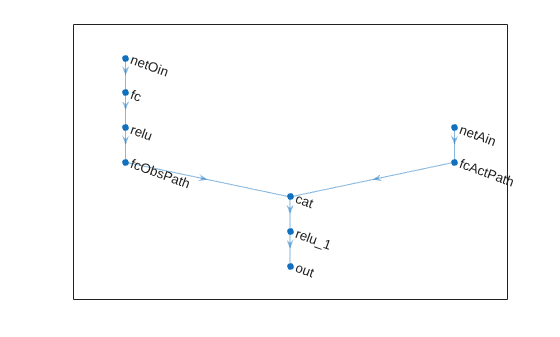
Define each network path as an array of layer objects, and assign names to the input and output layers of each path, so you can connect the paths.
% Observation path
obsPath = [
    featureInputLayer(prod(obsInfo.Dimension),Name="netOin")
    fullyConnectedLayer(24)
    reluLayer
    fullyConnectedLayer(24,Name="fcObsPath")
    ];

% Action path
actPath = [
    featureInputLayer(prod(actInfo.Dimension),Name="netAin")
    fullyConnectedLayer(24,Name="fcActPath")
    ];

% Common  path (concatenate inputs along dim #1)
commonPath = [
    concatenationLayer(1,2,Name="cat")
    reluLayer
    fullyConnectedLayer(1,Name="out")
    ];
Assemble dlnetwork object.
net = dlnetwork;
net = addLayers(net,obsPath);
net = addLayers(net,actPath);
net = addLayers(net,commonPath);
Connect layers.
net = connectLayers(net,"fcObsPath","cat/in1");
net = connectLayers(net,"fcActPath","cat/in2");
Plot network.
plot(net)
Initialize network and display the number of weights.
net = initialize(net);
summary(net)
   Initialized: true

   Number of learnables: 817

   Inputs:
      1   'netOin'   4 features
      2   'netAin'   1 features
Create the critic approximator object using net, the environment observation and action specifications, and the names of the network input layers to be connected with the environment observation and action channels. For more information, see rlQValueFunction.
critic = rlQValueFunction(net, ...
    obsInfo, ...
    actInfo, ...
    ObservationInputNames="netOin", ...
    ActionInputNames="netAin");
Check the critic with a random observation and action input.
getValue(critic,{rand(obsInfo.Dimension)},{rand(actInfo.Dimension)})ans = single
-0.0232
Create the DQN agent using the critic.
agent = rlDQNAgent(critic)
agent =
  rlDQNAgent with properties:

        ExperienceBuffer: [1×1 rl.replay.rlReplayMemory]
            AgentOptions: [1×1 rl.option.rlDQNAgentOptions]
    UseExplorationPolicy: 0
         ObservationInfo: [1×1 rl.util.rlNumericSpec]
              ActionInfo: [1×1 rl.util.rlFiniteSetSpec]
              SampleTime: 1
       UseGPUForLearning: "off"
         IntrinsicReward: []
Specify agent options, including training options for the critic.
agent.AgentOptions.UseDoubleDQN=false;
agent.AgentOptions.TargetUpdateMethod="periodic";
agent.AgentOptions.TargetUpdateFrequency=4;
agent.AgentOptions.ExperienceBufferLength=100000;
agent.AgentOptions.DiscountFactor=0.99;
agent.AgentOptions.MiniBatchSize=256;

agent.AgentOptions.CriticOptimizerOptions.LearnRate=1e-2;
agent.AgentOptions.CriticOptimizerOptions.GradientThreshold=1;
To check your agent, use the getAction function to return the action from a random observation.
getAction(agent,{rand(obsInfo.Dimension)})ans = 1×1 cell array
{[10]}
You can now test and train the agent within the environment.
For this example load the predefined environment used for the Train Default DQN Agent to Balance Discrete Cart-Pole example. This environment has a continuous four-dimensional observation space (the positions and velocities of both cart and pole) and a discrete one-dimensional action space consisting on the application of two possible forces, -10N or 10N.
env = rlPredefinedEnv("CartPole-Discrete");Get the observation and action specification objects.
obsInfo = getObservationInfo(env);
actInfo = getActionInfo(env);
For DQN agents, only the vector function approximator, rlVectorQValueFunction, supports recurrent neural networks models. The network must have one input layer (taking the content of the observation channel) and one output layer (returning the vector of values for all the possible actions).
Define the network as an array of layer objects. To create a recurrent neural network, use a sequenceInputLayer as the input layer and include at least one lstmLayer.
net = [
    sequenceInputLayer(prod(obsInfo.Dimension))
    fullyConnectedLayer(50)
    reluLayer
    lstmLayer(20,OutputMode="sequence");
    fullyConnectedLayer(20)
    reluLayer
    fullyConnectedLayer(numel(actInfo.Elements))
    ];
Convert to a dlnetwork object and display the number of weights.
net = dlnetwork(net);
summary(net);
   Initialized: true

   Number of learnables: 6.4k

   Inputs:
      1   'sequenceinput'   Sequence input with 4 channels
Create the critic approximator object using net and the environment specifications.
critic = rlVectorQValueFunction(net,obsInfo,actInfo);
Check your critic with a random input observation.
getValue(critic,{rand(obsInfo.Dimension)})ans = 2×1 single column vector
0.0136
0.0067
Define some training options for the critic.
criticOptions = rlOptimizerOptions( ...
    LearnRate=1e-3, ...
    GradientThreshold=1);
Specify options for creating the DQN agent. To use a recurrent neural network, you must specify a SequenceLength greater than 1.
agentOptions = rlDQNAgentOptions( ...
    UseDoubleDQN=false, ...
    TargetSmoothFactor=5e-3, ...
    ExperienceBufferLength=1e6, ...
    SequenceLength=32, ...
    CriticOptimizerOptions=criticOptions);

agentOptions.EpsilonGreedyExploration.EpsilonDecay = 1e-4;
Create the agent. The actor and critic networks are initialized randomly.
agent = rlDQNAgent(critic,agentOptions)
agent =
  rlDQNAgent with properties:

        ExperienceBuffer: [1×1 rl.replay.rlReplayMemory]
            AgentOptions: [1×1 rl.option.rlDQNAgentOptions]
    UseExplorationPolicy: 0
         ObservationInfo: [1×1 rl.util.rlNumericSpec]
              ActionInfo: [1×1 rl.util.rlFiniteSetSpec]
              SampleTime: 1
       UseGPUForLearning: "off"
         IntrinsicReward: []
Check your agent using getAction to return the action from a random observation.
getAction(agent,rand(obsInfo.Dimension))
ans = 1×1 cell array
    {[-10]}
To evaluate the agent using sequential observations, use the sequence length (time) dimension. For example, obtain actions for a sequence of 9 observations. Note that batch processing is not supported for recurrent neural networks, so the size of the third dimension must be one.
[action,state] = getAction(agent, ...
    {rand([obsInfo.Dimension 1 9])});
Display the action corresponding to the seventh element of the observation.
action = action{1};
action(1,1,1,7)
ans = -10
You can now test and train the agent within the environment.
Extended Capabilities
Version History
Introduced in R2019a
See Also
Apps
Functions
getAction|getActor|getCritic|getModel|generatePolicyFunction|generatePolicyBlock|getActionInfo|getObservationInfo
Objects
rlDQNAgentOptions|rlAgentInitializationOptions|rlVectorQValueFunction|rlQValueFunction|rlQAgent|rlLSPIAgent|rlSARSAAgent

