AI 検証
AI 検証手法を使用して、AI モデルや AI 駆動型システムが業界標準や規制に準拠しているかどうかを確認することにより、リスクを特定し、軽減します。AI Verification Library for Deep Learning Toolbox は、深層ニューラル ネットワークの特性を評価および検証するためのツールを提供します。たとえば、ネットワークのロバスト特性の検証、ネットワークの出力範囲の計算、敵対的サンプルの検索、分布から外れたデータの検出、および業界標準へのコンプライアンス チェックを行うことができます。さらに、Deep Learning Toolbox Interface for alpha-beta-CROWN Verifier サポート パッケージを使用すると、ロバスト特性の証明など、PyTorch® ネットワークおよび ONNX™ ネットワークの形式的検証を行うことができます。
関数
トピック
アルゴリズム
- Verification of Neural Networks
Learn about verification of neural networks using AI Verification Library for Deep Learning Toolbox™. - Verify Robustness of Deep Learning Neural Network
This example shows how to verify the adversarial robustness of a deep learning neural network. - Verify Robustness of Imported ONNX Network
This example shows how to verify the adversarial robustness of an imported ONNX™ deep neural network. (R2024a 以降) - Out-of-Distribution Detection for Deep Neural Networks
This example shows how to detect out-of-distribution (OOD) data in deep neural networks. - Train Robust Deep Learning Network with Jacobian Regularization
Train a neural network that is robust to adversarial examples using a Jacobian regularization scheme. - GPU でのネットワーク学習の再現
この例では、GPU でネットワークに複数回学習させ、同一の結果を得る方法を示します。 (R2024b 以降) - Uncertainty Estimation for Regression (Statistics and Machine Learning Toolbox)
Learn about estimating the uncertainty of the true response for a regression problem. - Train Custom Quantile Neural Network
This example shows how to customize and train a neural network that makes quantile predictions. (R2026a 以降) - Quantify Uncertainty in Object Detection Using Split Conformal Prediction
This example shows how to apply split conformal prediction (SCP) to an object detection model to quantify uncertainty in the predicted labels and bounding boxes. (R2026a 以降)
時系列
- 深層学習を使用したバッテリー充電状態の推定
要件の定義、データの準備、深層学習ネットワークの学習、ロバスト性の検証、Simulink へのネットワークの統合、モデルの展開を行う。 (R2024b 以降)
- ステップ 1: Define Requirements for Battery State of Charge Estimation
- ステップ 2: Prepare Data for Battery State of Charge Estimation Using Deep Learning
- ステップ 3: バッテリーの SOC を推定するための深層学習ネットワークの学習
- ステップ 4: Compress Deep Learning Network for Battery State of Charge Estimation
- ステップ 5: Test and Verify Deep Learning Network for Battery State of Charge Estimation
- ステップ 6: Integrate AI Model into Simulink for Battery State of Charge Estimation
- ステップ 7: Generate Code for Battery State of Charge Estimation Using Deep Learning
- ECG Signal Classification Using Deep Learning
This example shows how to develop and verify a deep learning model that classifies electrocardiogram (ECG) signals to detect atrial fibrillation (AFib). (R2026a 以降)
- ステップ 1: Define Requirements for ECG Signal Classification Using Deep Learning
- ステップ 2: Prepare Data for ECG Signal Classification
- ステップ 3: Train Deep Learning Network for ECG Signal Classification
- ステップ 4: Improve Adversarial Robustness of Deep Learning Network for ECG Signal Classification
- ステップ 5: Test Deep Learning Network for ECG Signal Classification
- ステップ 6: Out-of-Distribution Detection for ECG Signal Classification
- ステップ 7: Uncertainty Quantification for ECG Signal Classification
- ステップ 8: Investigate ECG Signal Classifications Using Grad-CAM
- ステップ 9: Build Deep Learning ECG Signal Classification App Using App Designer
表形式データ
- Verify and Deploy Airborne Collision Avoidance System (ACAS) Xu Neural Networks
Verify a set of neural networks trained for airborne collision avoidance integrated into a Simulink model using formal methods and scenario-based closed-loop testing. (R2026a 以降)
- ステップ 1: Explore ACAS Xu Neural Networks
- ステップ 2: Verify Local Robustness of ACAS Xu Neural Networks
- ステップ 3: Verify Global Stability of ACAS Xu Neural Networks
- ステップ 4: Verify Global Stability of ACAS Xu Neural Network Using Adaptive Mesh
- ステップ 5: Verify VNN-COMP Benchmark for ACAS Xu Neural Networks
- ステップ 6: Verify VNN-COMP Benchmark for ACAS Xu Neural Networks Using α,β-CROWN
- ステップ 7: Define and Verify AI Constituent Requirements for ACAS Xu Neural Networks
- ステップ 8: Integrate ACAS Xu Neural Networks into Simulink
- ステップ 9: Define and Verify AI System Requirements for ACAS Xu Neural Networks Integrated Into Simulink
ビジョン
- Generate Untargeted and Targeted Adversarial Examples for Image Classification
This example shows how to use the fast gradient sign method (FGSM) and the basic iterative method (BIM) to generate adversarial examples for a pretrained neural network. - Train Image Classification Network Robust to Adversarial Examples
This example shows how to train a neural network that is robust to adversarial examples using fast gradient sign method (FGSM) adversarial training. - Generate Adversarial Examples for Semantic Segmentation
This example shows how to generate adversarial examples for a semantic segmentation network using the basic iterative method (BIM). - Out-of-Distribution Data Discriminator for YOLO v4 Object Detector
This example shows how to detect out-of-distribution (OOD) data in a YOLO v4 object detector. - Verify an Airborne Deep Learning System
This example shows how to verify a deep learning system for airborne applications and is based on the work in [5,6,7], which includes the development and verification activities required by DO-178C [1], ARP4754A [2], and prospective EASA and FAA guidelines [3,4]. (R2023b 以降)
テキスト
- Out-of-Distribution Detection for BERT Document Classifier
This example shows how to detect out-of-distribution data for a BERT document classifier. (R2024b 以降) - Out-of-Distribution Detection for LSTM Document Classifier
This example shows how to detect out-of-distribution (OOD) data in an LSTM document classifier. (R2024a 以降)
認証ワークフロー
- Runway Sign Classifier: Certify an Airborne Deep Learning System (DO Qualification Kit)
Demonstrates the certification of airborne deep learning system.
注目の例

Verify Robustness of Deep Learning Neural Network
Verify the adversarial robustness of a deep learning neural network.

Out-of-Distribution Detection for Deep Neural Networks
Detect out-of-distribution (OOD) data in deep neural networks.
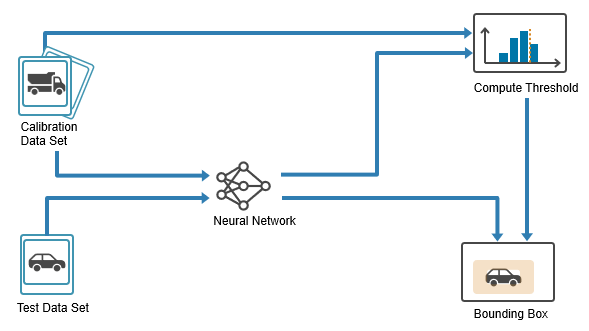
Quantify Uncertainty in Object Detection Using Split Conformal Prediction
Apply split conformal prediction (SCP) to an object detection model to quantify uncertainty in the predicted labels and bounding boxes.

Verify an Airborne Deep Learning System
Verify a deep learning system for airborne applications and is based on the work in [5,6,7], which includes the development and verification activities required by DO-178C [1], ARP4754A [2], and prospective EASA and FAA guidelines [3,4]. To verify that the system complies with aviation industry standards and prospective guidelines, including activities such as requirements tracing, testing and reporting, see Runway Sign Classifier: Certify an Airborne Deep Learning System (DO Qualification Kit).
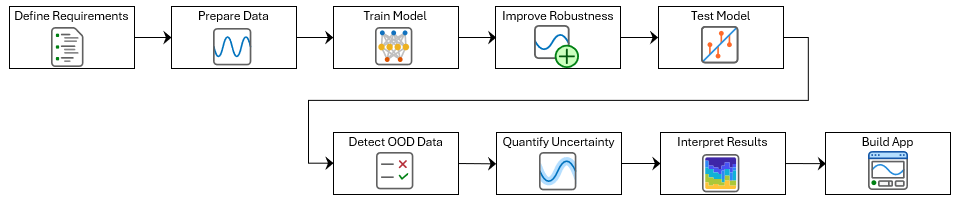
ECG Signal Classification Using Deep Learning
Develop and verify a deep learning model that classifies electrocardiogram (ECG) signals to detect atrial fibrillation (AFib). The example guides you through a complete workflow for building an AI system, with a focus on robustness, explainability, and verification against defined requirements.
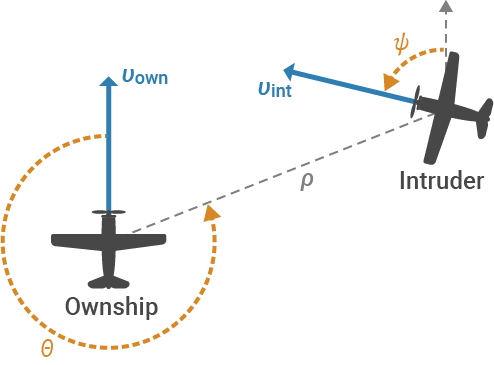
Verify and Deploy Airborne Collision Avoidance System (ACAS) Xu Neural Networks
Verify a set of neural networks trained for airborne collision avoidance integrated into a Simulink model using formal methods and scenario-based closed-loop testing.

