transmitRepeat
R2026bSyntax
Description
Add-On Required: This feature requires the Wireless Testbench Support Package for NI USRP Radios add-on.
Examples
Create and initialize the transmitter System object. Set the interpolation factor.
sampleRate = 1e6;
tx = comm.SDRuTransmitter(Platform="X310",IPAddress='192.168.40.2',...
    CenterFrequency=2e9,Gain=20);
tx.InterpolationFactor = tx.MasterClockRate/sampleRate;
Create and initialize the receiver System object. Set the decimation factor.
rx = comm.SDRuReceiver(Platform="X310",IPAddress='192.168.40.2',...
    CenterFrequency=2e9,Gain=20);
rx.DecimationFactor = rx.MasterClockRate/sampleRate;
Generate a sine wave for transmission.
sinewave = dsp.SineWave(1,50e3);
sinewave.SampleRate = sampleRate;
sinewave.SamplesPerFrame = 2e4;
sinewave.OutputDataType = 'double';
sinewave.ComplexOutput = true;
txData = sinewave();
Initialize the time scope and spectrum analyzer for visualization.
timeScope = timescope(SampleRate=sampleRate);
spectrumScope = spectrumAnalyzer(SampleRate=sampleRate, ...
ViewType="spectrum");
spectrumScope.PeakFinder.Enabled = true;
Use the transmitRepeat function to transmit the sine wave in the background.
samplePerFrame = 2e4;
stopTime = 1;
transmitRepeat(tx,txData);
## Waveform transmission has started successfully and will repeat indefinitely. Call the stopTransmission() method to stop the transmission.
pause(10)
disp('Transmission started')
Transmission started
Receive the sine wave in the foreground using the receiver System object. Use the isTransmitting function to check if transmission is ongoing. Visualize the received data using the time scope and spectrum analyzer.
if isTransmitting(tx)
    for i = 1:40
        [data, ~] = rx();
timeScope(data)
spectrumScope(data)
    end
end
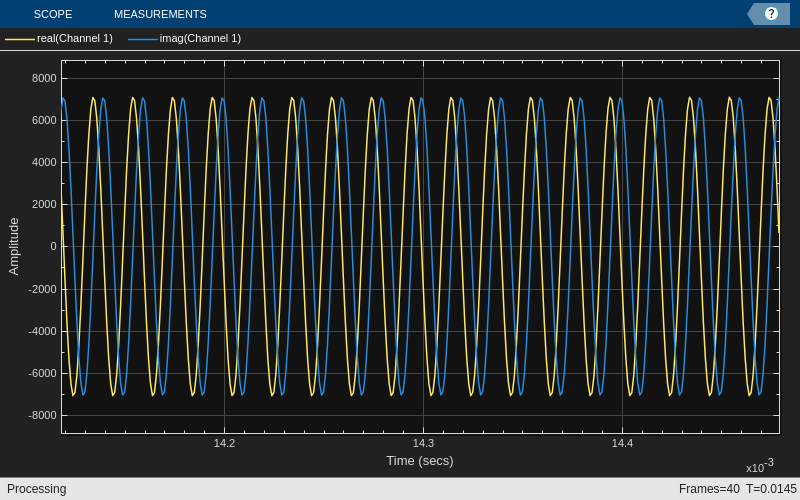
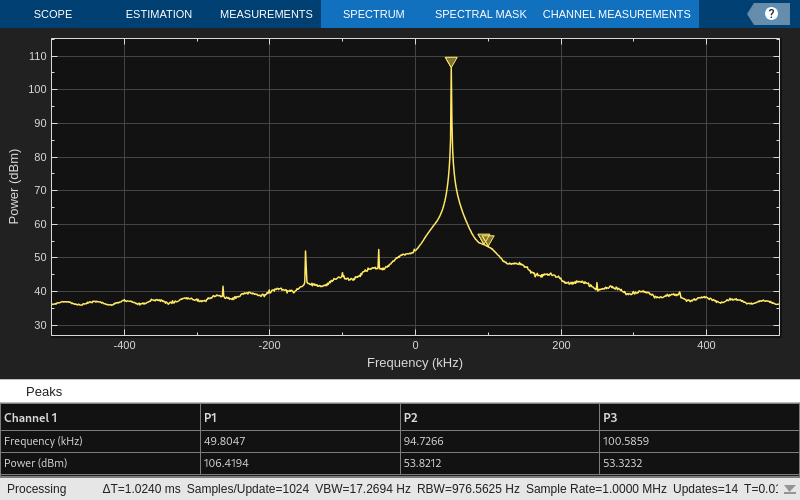
Stop the background transmission.
stopTransmission(tx);
disp('Transmission ended')
Transmission ended
Release the transmitter and receiver System objects.
release(tx);
release(rx);
Input Arguments
Version History
Introduced in R2026a

