エンドツーエンドの AI ワークフロー
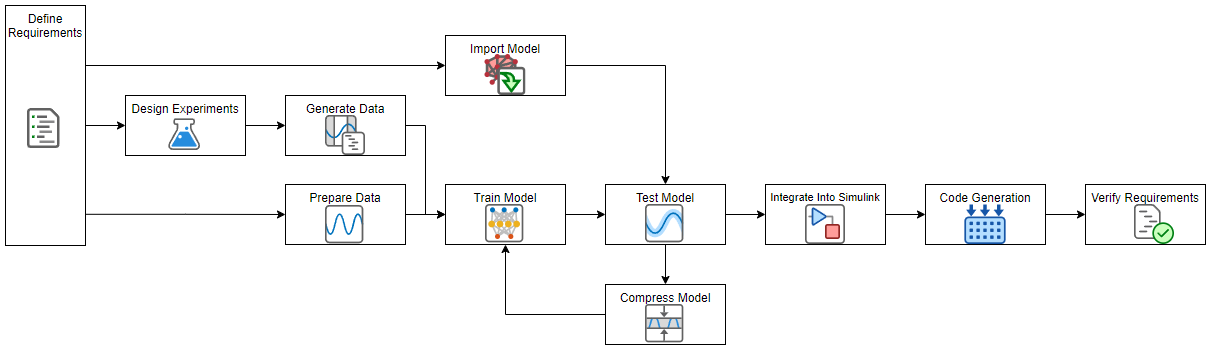
R2026b要件定義、データ準備、深層ニューラル学習、圧縮、ネットワークのテストと検証、Simulink 連携、展開などのエンドツーエンドのワークフローで Deep Learning Toolbox™ を使用します。
トピック
- 深層学習を使用したバッテリー充電状態の推定
要件の定義、データの準備、深層学習ネットワークの学習、ロバスト性の検証、Simulink へのネットワークの統合、モデルの展開を行う。 (R2024b 以降)
- ステップ 1: Define Requirements for Battery State of Charge Estimation
- ステップ 2: Prepare Data for Battery State of Charge Estimation Using Deep Learning
- ステップ 3: バッテリーの SOC を推定するための深層学習ネットワークの学習
- ステップ 4: Compress Deep Learning Network for Battery State of Charge Estimation
- ステップ 5: Test and Verify Deep Learning Network for Battery State of Charge Estimation
- ステップ 6: Integrate AI Model into Simulink for Battery State of Charge Estimation
- ステップ 7: Generate Code for Battery State of Charge Estimation Using Deep Learning
- ステップ 8: Deploy Code for Battery State of Charge Estimation Using Deep Learning
- Train and Compress AI Model for Road Damage Detection
Train and compress a sequence classification network using pruning, projection, and quantization to meet a fixed memory requirement. (R2025a 以降)
- ステップ 1: Train Sequence Classification Network for Road Damage Detection
- ステップ 2: Compress Sequence Classification Network for Road Damage Detection
- ステップ 3: Tune Compression Parameters for Sequence Classification Network for Road Damage Detection
- ステップ 4: Generate Simulink Model from Sequence Classification Network for Road Damage Detection
- ECG Signal Classification Using Deep Learning
This example shows how to develop and verify a deep learning model that classifies electrocardiogram (ECG) signals to detect atrial fibrillation (AFib). (R2026a 以降)
- ステップ 1: Define Requirements for ECG Signal Classification Using Deep Learning
- ステップ 2: Prepare Data for ECG Signal Classification
- ステップ 3: Train Deep Learning Network for ECG Signal Classification
- ステップ 4: Improve Adversarial Robustness of Deep Learning Network for ECG Signal Classification
- ステップ 5: Test Deep Learning Network for ECG Signal Classification
- ステップ 6: Out-of-Distribution Detection for ECG Signal Classification
- ステップ 7: Uncertainty Quantification for ECG Signal Classification
- ステップ 8: Investigate ECG Signal Classifications Using Grad-CAM
- ステップ 9: Build Deep Learning ECG Signal Classification App Using App Designer
- Verify and Deploy Airborne Collision Avoidance System (ACAS) Xu Neural Networks
Verify a set of neural networks trained for airborne collision avoidance integrated into a Simulink model using formal methods and scenario-based closed-loop testing. (R2026a 以降)
- ステップ 1: Explore ACAS Xu Neural Networks
- ステップ 2: Verify Local Robustness of ACAS Xu Neural Networks
- ステップ 3: Verify Global Stability of ACAS Xu Neural Networks
- ステップ 4: Verify Global Stability of ACAS Xu Neural Network Using Adaptive Mesh
- ステップ 5: Verify VNN-COMP Benchmark for ACAS Xu Neural Networks
- ステップ 6: Verify VNN-COMP Benchmark for ACAS Xu Neural Networks Using α,β-CROWN
- ステップ 7: Define and Verify AI Constituent Requirements for ACAS Xu Neural Networks
- ステップ 8: Integrate ACAS Xu Neural Networks into Simulink
- ステップ 9: Define and Verify AI System Requirements for ACAS Xu Neural Networks Integrated Into Simulink
- Verify an Airborne Deep Learning System
This example shows how to verify a deep learning system for airborne applications and is based on the work in [5,6,7], which includes the development and verification activities required by DO-178C [1], ARP4754A [2], and prospective EASA and FAA guidelines [3,4]. (R2023b 以降)
注目の例
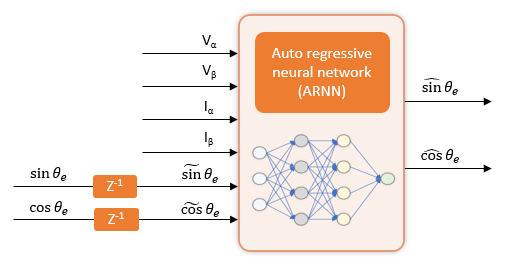
Field-Oriented Control of PMSM Using Position Estimated by Neural Network
Implement field-oriented control (FOC) of a permanent magnet synchronous motor (PMSM) using a rotor position estimated by an autoregressive neural network (ARNN) trained with Deep Learning Toolbox™.

