Plotting a heatmap with collected data
古いコメントを表示
I have an image of a map with data allocated to different points on the map. Am I able to get co-ordinates of that image to place the data it's allocated spots and produce a heatmap over the image? Perhaps there is a better way of doing this?

採用された回答
Use function pcolor is another option.
clear;clc;
im = imread('map.png');
[Ny,Nx,Nc] = size(im);
f = figure(1);
ax = gca;
minSignal = 20;
maxSignal = 800;
X = repmat(linspace(minSignal,maxSignal,Nx),Ny,1); % Dummy data only
h = imagesc(ax,1:Nx, 1:Ny,im);
hold(ax,'on');
s=pcolor(ax,X);
s.FaceColor = 'interp';
s.FaceAlpha = 0.5;
s.EdgeColor = 'none';
axis(ax,'image');
cmap = colormap(ax,hsv);
cb = colorbar(ax);
title(cb,'Signal Level');
axis(ax,'off');

17 件のコメント

jason.dim
2022 年 3 月 10 日
Suppose your data is across the map in lateral direction (from left to right).
I would resize the image in this direction so that I am able to put the data without any interpolation.
In the following example, the number of row and column of the original image (Variable im) are 342 and 430 respectively. I don't care the number of rows since your data has only 1 row, so I resize the number of columns from 430 to 420 so that all data can be fitted just by repeating the data.
The next step is to repeat the signal to match the number of the columns in the image. For each signal, it occupy 20 columns in the image. After that, repeat the expanded signal in row direction, which is 342 in this case.
clear;clc;
im = imread('map.png');
[Ny,Nx,Nc] = size(im); % Determine the size of the image
%
Sig = [-104 -97 -105 -99 -95 -83 -95 -109 -104 -105 -82 -85 -89 -104 -97 -103 -83 -84 -84 -84];
Nz = length(Sig); % Number of data in the signal
extra_Nx = mod(Nx,Nz);
im_resize = imresize(im, [Ny,Nx-extra_Nx]); % Resize the image based on number of the signal
[~,Nx_new,~] = size(im_resize);
rep_Sig = repelem(Sig,1,Nx_new/Nz); % Repeat signal to fit column number of the image
rep_Sig = repmat(rep_Sig,Ny,1); % Repeat signal to fit row number of the image
%
f = figure(1);
ax = gca;
h = imagesc(ax,1:Nx_new, 1:Ny,im_resize);
hold(ax,'on');
s=pcolor(ax,rep_Sig);
s.FaceColor = 'interp';
s.FaceAlpha = 0.3; % You may adjust this value
s.EdgeColor = 'none';
axis(ax,'image');
cmap = colormap(ax,flipud(autumn)); % Inverse the colormap darker color represent higher signal
cb = colorbar(ax);
title(cb,'Signal Level');
%% The following is only for display only, you may not need the following lines
xtext = linspace(Nz/2+1,Nx_new-Nz/2,Nz);
ytext = repelem(Ny/2,1,Nz);
text(ax,xtext,ytext,num2str(Sig'),'HorizontalAlignment','center','FontSize',6);
axis(ax,'off');

jason.dim
2022 年 3 月 11 日
Now I understand:
clear; clc;
data = imread('map.png'); % Read the image
BW1 = ~rgb2gray(data); % Convert to gray scale and invert
SE = strel('disk',5);
BW2 = bwareafilt(BW1,1); % Find the largest rectange
CC = bwconncomp(imdilate(BW1-BW2,SE)); % Use image dilate
s = regionprops(CC,'Centroid','BoundingBox'); % Find the centroid and bounding box (optional)
pos = round(cat(1,s.Centroid)); % Combine the centroid as a matrix
imshow(data)
hold on
plot(pos(:,1),pos(:,2),'g*') % Plot the detected location

pos
jason.dim
2022 年 3 月 11 日
It depends how you extract the blobs from the image.
You may highlight your map with distinct color as below, so that it is easy to extract the correct location of your points.
data = imread('map2.png');
[R,G,B] = imsplit(data);
maskR = R>220;
maskG = G>180;
maskB = B<20;
BW1 = maskR & maskG & maskB;
CC = bwconncomp(BW1);
s = regionprops(CC,'Centroid');
pos = round(cat(1,s.Centroid));
imshow(data)
hold on
plot(pos(:,1),pos(:,2),'g*')

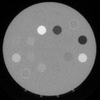
Following the method as you mentioned, I get the following:

jason.dim
2022 年 3 月 11 日
Simon Chan
2022 年 3 月 11 日
編集済み: Simon Chan
2022 年 3 月 11 日
Possible to elaborate the issue?
You may exclude the outer area and get this:

jason.dim
2022 年 3 月 11 日
jason.dim
2022 年 3 月 11 日
use function round
xi = [234.6; 563.4];
xi = round(xi)
jason.dim
2022 年 3 月 14 日
jason.dim
2022 年 3 月 14 日
Do transpose when you want the data to switch from a column vector to row vector and vice versa.
xi = [43; 335; 644; 891; 889; 669] % Coordinates frm getpts
Do the transpose when you want to dispay it in command window.
xii = transpose(xi) % Transpose
jason.dim
2022 年 3 月 15 日
jason.dim
2022 年 3 月 15 日
Simon Chan
2022 年 3 月 16 日
Congratulations.
その他の回答 (0 件)
カテゴリ
ヘルプ センター および File Exchange で Color and Styling についてさらに検索
Community Treasure Hunt
Find the treasures in MATLAB Central and discover how the community can help you!
Start Hunting!
Translated by 

