このページの内容は最新ではありません。最新版の英語を参照するには、ここをクリックします。
信号伝搬とターゲット
R2026aレーダー システムまたはソナー システムのシミュレーションには、電波伝搬、クラッターと干渉、アレイとターゲットの動き、ターゲット断面のモデルが必要です。Phased Array System Toolbox™ を使用すると、モノスタティックまたはバイスタティックのシナリオで自由空間信号伝搬をモデル化できます。あるいは、2 波伝搬モデルを使用して単純なマルチパス伝搬を採用することもできます。見通し内 (LOS) 伝搬モデルを使用して大気減衰をモデル化できます。これらのモデルは、大気ガス、雨、霧、および雲を通る信号の伝搬を計算します。すべてのモデルには、レンジ依存時間遅延、位相シフト、ドップラー シフト、および自由空間損失が含まれます。非偏波放射の散乱レーダー断面積 (RCS) または偏波放射の散乱行列を指定できます。ツールボックスは、4 つの標準的な Swerling ターゲット レーダー断面積モデルを実装しています。ツールボックスは、等速度および等加速度の運動モデルをサポートしています。
ツールボックスは、マルチパス伝搬モデル、ハイドロフォン モデルとプロジェクター モデル、水中ノイズ源、ターゲット強度モデルを提供することにより、ソナー システムのシミュレーションをサポートします。ターゲット強度モデルを使用すると、変動しないターゲットと Swerling 変動するターゲットを作成できます。
ツールボックスは、点状の反射体によるターゲットの反射と散乱をモデル化します。非偏波放射の散乱レーダー断面積 (RCS) または偏波放射の散乱行列を指定できます。4 つの標準的な Swerling ターゲット散乱モデルが実装されています。後方散乱レーダー シナリオの特殊なケース向けに、角度に依存するレーダー断面積モデルをシミュレーションできます。レーダー断面積モデルは、狭帯域信号と広帯域信号の両方に適用されます。ソナー シナリオで 4 つの標準的な Swerling 後方散乱モデルをシミュレーションすることもできます。ソナー システムのシミュレーション向けに、ターゲット強度モデルを採用し、水中のノイズ源を作成できます。
オブジェクト
phased.RadarTarget | Radar target |
phased.BackscatterRadarTarget | Backscatter radar target |
phased.BackscatterSonarTarget | Sonar target backscatter |
phased.WidebandBackscatterRadarTarget | Backscatter wideband signal from radar target |
phased.FreeSpace | Free-space environment |
phased.LOSChannel | Narrowband LOS propagation channel |
phased.ScatteringMIMOChannel | Scattering MIMO channel |
phased.IsoSpeedUnderwaterPaths | Isospeed multipath sonar channel |
phased.MultipathChannel | Propagate signals in multipath channel |
phased.WidebandFreeSpace | Wideband free-space propagation |
phased.WidebandLOSChannel | Wideband LOS propagation channel |
phased.UnderwaterRadiatedNoise | Radiate acoustic noise from underwater or surface sound source |
ブロック
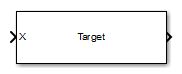 | Radar Target | Radar target |
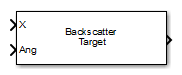 | Backscatter Radar Target | Backscatter radar target |
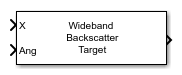 | Wideband Backscatter Radar Target | Backscatter wideband signals from radar target |
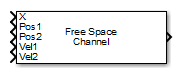 | Free Space | Free space environment |
 | LOS Channel | Narrowband line-of-sight propagation channel |
 | Scattering MIMO Channel | Scattering MIMO propagation channel |
 | Wideband Free Space | Wideband free space environment |
 | Wideband LOS Channel | Wideband line-of-sight propagation channel |
 | Range Angle Calculator | Range and angle calculations |
 | Azimuth Broadside Converter | Convert azimuth angle to broadside angle or broadside angle to azimuth angle |
関数
fogpl | RF signal attenuation due to fog and clouds |
fspl | 自由空間パス損失 |
gaspl | RF signal attenuation due to atmosphere gaseous absorption |
rainpl | RF signal attenuation due to rainfall using ITU model |
cranerainpl | RF signal attenuation due to rainfall using Crane model |
tirempl | Path loss using Terrain Integrated Rough Earth Model (TIREM) |
rangeangle | Range and angle calculation |
scatteringchanmtx | Scattering channel matrix |
waterfill | Waterfill MIMO power distribution |
physconst | 物理定数 |
トピック
- Free Space Path Loss
Propagation environments have significant effects on the amplitude, phase, and shape of propagating space-time wavefields.
- Two-Ray Multipath Propagation
A two-ray propagation channel is the next step up in complexity from a free-space channel and is the simplest case of a multipath propagation environment.
- Radar Target
Model targets with fluctuating and nonfluctuating radar cross-sections.

