Fluid Transport
R2026bIn this section, you can find examples of fluid transport in multiple Simscape Fluids domains.
Featured Examples
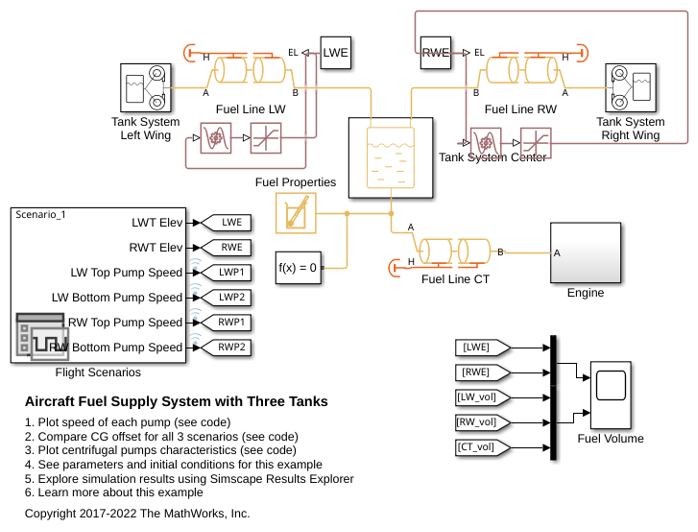
Aircraft Fuel Supply System with Three Tanks
Model an aircraft fuel supply system consisting of three tanks and an engine.
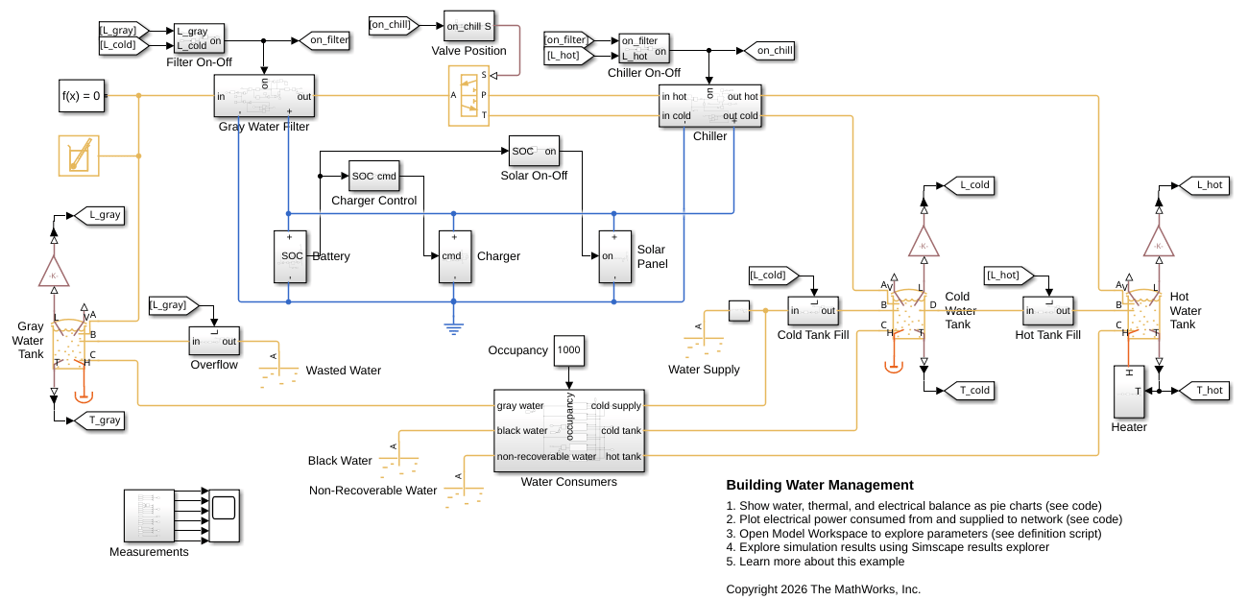
Building Water Management
Simulates a water and energy saving system in a commercial building, such as a hotel. The wastewater is recycled with a filtering system, and the heat contained in the wastewater is recovered with a refrigeration system. A solar panel and battery storage system mitigate the energy cost of running the filtering and refrigeration system.
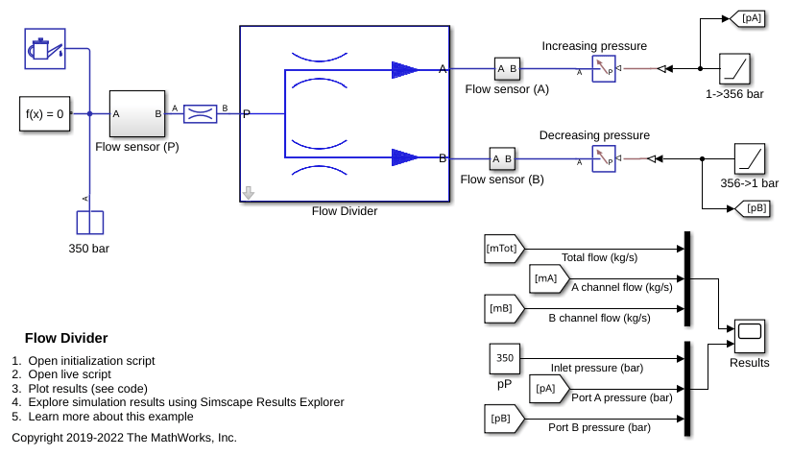
Flow Divider
A simple way of modeling of a flow divider and using it with a load harness. The flow divider helps divide the input flow in desired percentage when the loads connected to the two lines are unequal. The flow divider allows flow only in forward direction. When it is used with loads where unloading is done through reverse flows, it should be used with direction control valves.
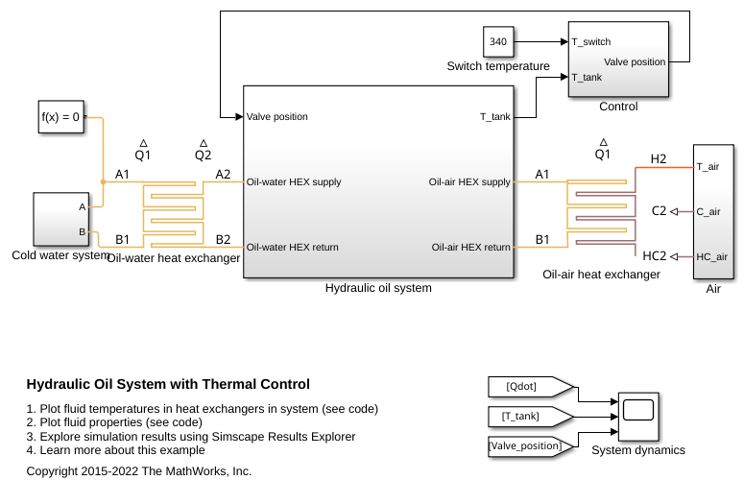
Hydraulic Oil System with Thermal Control
A hydraulic oil system with a thermal control using Simscape™ Fluids™ Thermal Liquid blocks. The hydraulic oil system consists of an oil storage tank represented by the Tank (TL) block with two inlets, a pump represented by a Mass Flow Rate Source (TL) block, and pipelines represented by Pipe (TL) block.
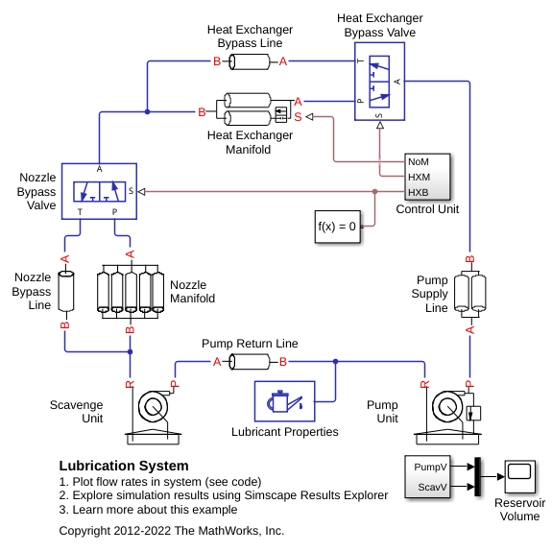
Lubrication System
A simplified version of a lubrication system fed with the centrifugal pump. The system consists of five major units: Pump Unit, Scavenge Unit, Heat Exchanger Manifold, Nozzle Manifold, and Control Unit. Both the pump and the scavenge unit are built around the centrifugal pump. The Scavenge Unit collects fluid discharged by nozzles and pumps it back into the reservoir of the Pump Unit. The Control Unit generates commands to bypass either the heat exchanger, represented as a local resistance, or the nozzles block. In a real system, these commands are generated by temperature sensors installed in lubrication cavities.
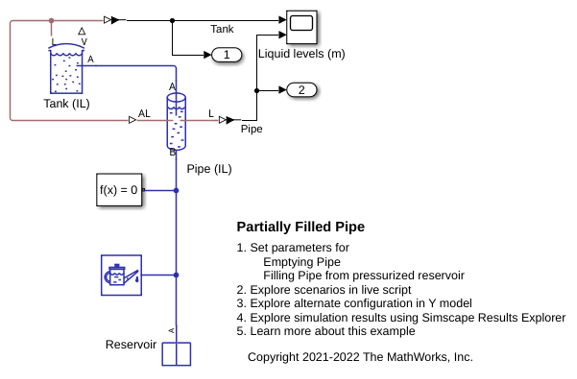
Partially Filled Pipe
The Partially Filled Pipe (IL) block used to model the emptying and filling of a tank in multiple configurations. The block represents an arbitrarily full pipe in an isothermal liquid network. The block assumes that port A is higher than port B. The physical signal input AL indicates the relative liquid level of the block that is connected to port A. When the signal AL is less than or equal to 0, the block assumes there is no liquid is entering port A.
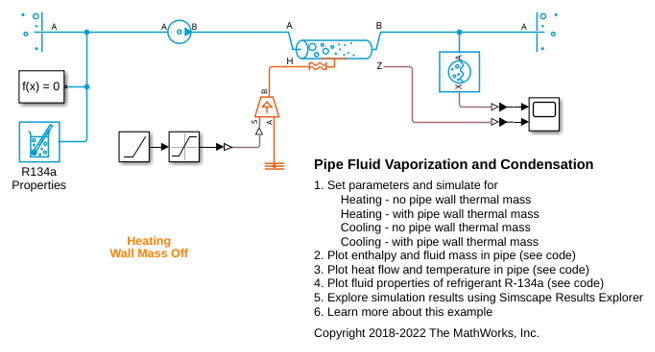
Pipe Fluid Vaporization and Condensation
The 3-Zone Pipe (2P) block used to model vaporization or condensation of fluid flow in a pipe. The block divides the internal fluid volume into up to three zones: liquid zone, mixture zone, and vapor zone, depending on the state of the fluid along the pipe. As fluid flows through the pipe, heat is transferred between the environment external to the pipe and the fluid inside the pipe, causing it to change from liquid to mixture to vapor for the heating case or from vapor to mixture to liquid for the cooling case. The effect of thermal storage in the pipe wall can be optionally turned on by specifying a nonzero pipe wall thickness.
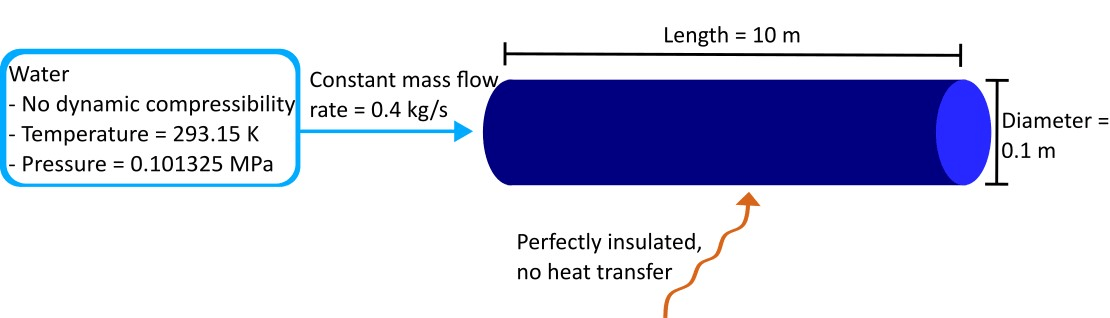
Pressure Loss and Mass Flow Rate in a Thermal Liquid Pipe
How changes in pipe and fluid attributes, such as friction and elevation change, impact the pressure loss through a pipe and how enabling dynamic compressibility impacts the mass flow rate. These effects are especially important in long, narrow pipes because they ensure the flow pressure is strong enough to overcome the pressure loss. This example uses the Simscape™ Fluids™ Pipe (TL) block.
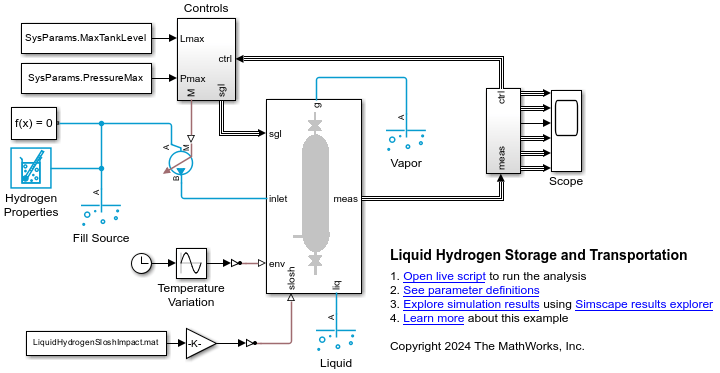
Liquid Hydrogen Storage and Transportation
Model a cryogenic tank by using Simscape™ Fluids™ blocks. Aviation and aerospace applications commonly use liquid hydrogen storage instead of compressed gas storage. Engineering challenges include minimizing liquid boil-off, managing tank internal pressure, and designing a robust storage tank.
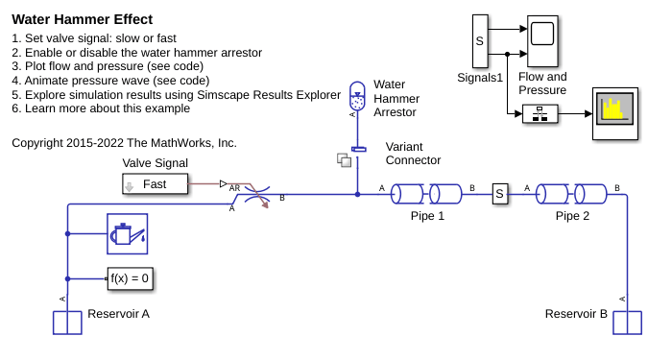
Water Hammer Effect
This demo shows how the Isothermal Liquid library can be used to model water hammer in a long pipe. After opening a valve to slowly establish steady flow in the pipe, the valve is quickly shut. If the Valve is shut quickly enough, it triggers a water hammer effect. A water hammer arrestor suppresses the pressure spikes.

