Cylindrical Tube With Thermoviscous Losses Using Foster Network
R2026bCylindrical Tube With Thermoviscous Losses Using Foster Network block

To add a block to a model, double-click the canvas and start typing the block name. Then, select the block from the list.
Libraries:
Simscape Acoustics /
Applications /
Tubes and Horns
Description
Add-On Required: This feature requires the Simscape Acoustics add-on.
This block models the transmission line of a cylindrical tube with thermoviscous losses. By default, the tube is modeled with auxiliary circuit branches using a Foster network expansion [1]. The tube is modeled using N segments, where each segment includes auxiliary circuit branches that approximate the frequency-dependent viscous and thermal boundary effects. For more information, see Foster Network Equivalent Circuit.
Specify Select tube model as "Simple
Model" to model the tube using a single transmission line where the tube is not
segmented [2]. The simple model is
suitable for tubes with small dimensions compared to the wavelength of the propagating
wave.
Examples
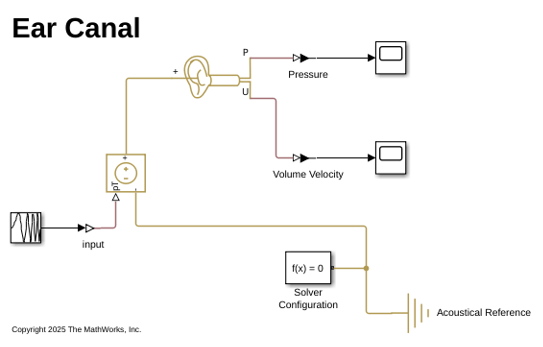
Model Ear Canal
Model the acoustic response of an ear canal using Simscape™ Acoustics.
Ports
Conserving
Parameters
More About
When you set Select tube model to "Differential
Branches", the Cylindrical Tube With Thermoviscous Losses Using
Foster Network block implements a continued-fraction circuit expansion
with N segments. Each segment is modeled using a T-network architecture,
resulting in a cascaded T-network or Cauer ladder network lumped-element model. Each
component of the ladder network is a subnetwork. The figure shows the high-level
architecture for an equivalent circuit with Number of differential tube lengths set to 3.
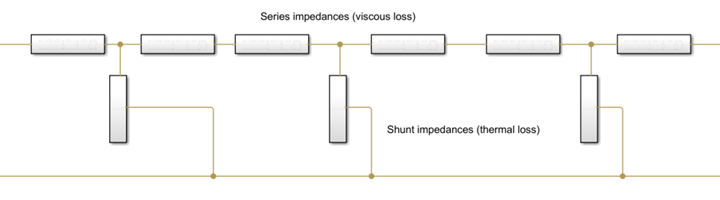
The block models viscous loss with series impedance components. Each series impedance subnetwork is an infinite network comprised of an initial Acoustic Resistance block followed by pairs of Acoustic Inertance and Acoustic Resistance blocks. The number of pairs is determined by the Order of thermoviscous approximation parameter. The figure shows the equivalent circuit of a series impedance component with an order of 4. The equivalent circuit is derived from Figure 4 of the reference that defined the network model [3], with values calculated using an updated derivation [1].

The block models thermal loss with shunt impedance components. Each shunt impedance subnetwork is an infinite network comprised of an initial Acoustic Compliance block and Acoustic Resistance block, followed by pairs of Acoustic Compliance and Acoustic Resistance blocks. The number of pairs is determined by the Order of thermoviscous approximation parameter. The figure shows the equivalent circuit of a shunt impedance component with an order of 4. The equivalent circuit is derived from Figure 4 of the reference that defined the network model [3], with values calculated using an updated derivation [1]

In practice, the Cylindrical Tube With Thermoviscous Losses Using Foster Network collapses consecutive series impedance blocks from the equivalent circuits into a single block. The resulting model is numerically identical to the equivalent circuit but uses fewer components.
References
[1] Thibault, Alexis, and Juliette Chabassier. “Dissipative Time-Domain One-Dimensional Model for Viscothermal Acoustic Propagation in Wind Instruments.” The Journal of the Acoustical Society of America 150, no. 2 (2021): 1165–75. https://doi.org/10.1121/10.0005537.
[2] Thompson, Stephen C., Thomas B. Gabrielson, and Daniel M. Warren. “Analog Model for Thermoviscous Propagation in a Cylindrical Tube.” The Journal of the Acoustical Society of America 135, no. 2 (2014): 585–90. https://doi.org/10.1121/1.4861237.
[3] Bilbao, Stefan, and Reginald Harrison. “Passive Time-Domain Numerical Models of Viscothermal Wave Propagation in Acoustic Tubes of Variable Cross Section.” The Journal of the Acoustical Society of America 140, no. 1 (2016): 728–40. https://doi.org/10.1121/1.4959025.
Version History
Introduced in R2026b

