Operational Modal Analysis using NEXT-LSCE algorithm

Operational modal analysis using Natural Excitation Technique (NEXT) coupled to the Linear Square Complex Exponential (LSCE) method

現在この提出コンテンツをフォロー中です。

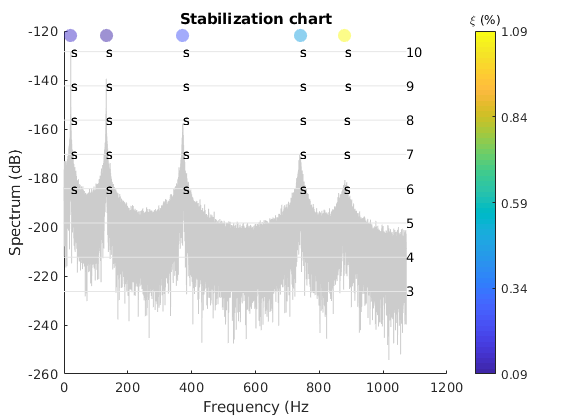
LSCE_NEXT permits to identify modal parameters (frequency and modal damping) using the Natural Excitation Technique (NEXT) coupled to the Linear Square Complex Exponential (LSCE) method. This operational modal analysis algorithm is based only on sensors measurements and requires at least three sensors. This method is well adapted for multiple degrees of freedom systems in the case of white noise or ambient excitation particularly when the excitation cannot be measured. The choice of the identification order and the selection of the physical poles are assisted by a stabilization chart using frequency and damping convergence criteria. For more information, run the example file 'LSCE_NEXT_file_test.m'.

Some works using the proposed function can be found in the following references:
* B. Chomette and J-L. Le Carrou, Operational modal analysis applied to the concert harp, Mechanical Systems and Signal Processing 56, 81-91, 2015.
* J-L. Le Carrou, A. Paté and B. Chomette, Influence of the instrumentalist on the dynamics of the electric guitare, Journal of the Acoustical Society of America 146 (5), 3123-3130, 2019

引用

Baptiste Chomette (2026). Operational Modal Analysis using NEXT-LSCE algorithm (https://jp.mathworks.com/matlabcentral/fileexchange/73489-operational-modal-analysis-using-next-lsce-algorithm), MATLAB Central File Exchange. に取得済み.

カテゴリ

Help Center および MATLAB AnswersVibration Analysis についてさらに検索

一般的な情報

MATLAB リリースの互換性

  • すべてのリリースと互換性あり

プラットフォームの互換性

  • Windows
  • macOS
  • Linux
バージョン 公開済み リリース ノート Action
1.0.4

The function add_poles.m has been added to add poles to the stabilization chart using round marker with color
proportional to the modal damping factor.

1.0.3

A few corrections in the description

1.0.2

Some corrections in the description.

1.0.1

New description

1.0.0