uifitcircle
R2026bDescription
The uifitcircle object displays a circle measurement tool on an
image object that you create using the imageshow
function. You can use this measurement tool to interactively measure circles in an
image.
To automatically adjust or correct the placement of the measurement tool to align
precisely with a circle edge, use the snap object function. To programmatically measure circles, use the fitcircle function.
Creation
Description
sets writable properties using one or more name-value arguments.hCircle = uifitcircle(hImage,PropertyName=Value)
For example, Snap="true" specifies to snap the circle you
interactively define using the circle tool to a circular edge in the image.
Input Arguments
Input image object, specified as an
images.ui.graphics.Image object. To create this image
object, use the imageshow function.
Note
By default, spatial image coordinates are in the intrinsic coordinate
system, where the center of the upper left pixel has intrinsic coordinates
(1.0, 1.0). If you perform a coordinate transformation on the image input to
the hImage argument, units are defined in the world
coordinate system. To learn more, see Image Coordinate Systems.
Name-Value Arguments
Specify optional pairs of arguments as
Name1=Value1,...,NameN=ValueN, where Name is
the argument name and Value is the corresponding value.
Name-value arguments must appear after other arguments, but the order of the
pairs does not matter.
Example: uifitcircle(hImage,Snap="true") specifies to snap the
circle you interactively define using the circle tool to a circular edge in the
image
Position of the circle tool, specified as one of these options:
Position format | Description |
|---|---|
| 3-element row vector | The vector is of the form [xCenter yCenter R], where the [xCenter yCenter] coordinate is the center of the circle and R is the circle radius. |
| N-by-2 matrix | Each row in the matrix represents a coordinate point to which the circle is fit. |
You can specify Position programmatically, or
interactively by clicking a start point in the displayed image
and then clicking the vertex and end
point.hImage
Snap the circle to edges during interactive placement, specified as a
numeric or logical 1 (true) or
0 (false). If you specify
Snap as true, the tool detects
nearby circular edges using the method specified by the
EdgeMap argument, and then fits the circle to the
edges using the Random Sample Consensus (RANSAC) algorithm.
Specify the snapping neighborhood using the
SnapNeighborhood argument.
Snapping neighborhood, specified as a positive scalar.
SnapNeighborhood specifies a band-shaped search
region for edge snapping, specified as a fraction of the circle radius. The
algorithm searches for edges within an annular neighborhood extending from
(1 – S)R to
(1 + S) R around the circle’s
circumference. S is the value of
SnapNeighborhood, and R is the
radius of the circle. Units are in pixels.
Number of RANSAC iterations to run to detect the most accurately snapped circle, specified as a positive integer. RANSAC algorithm for circle estimation involves repeated random sampling steps to robustly estimate the parameters of a circle from a set of measurement points. Increase the number of iterations to increase the chance that at least one sample contains only inliers (points in the true circle), leading to a good model at the expense of longer computation time.
Inlier distance threshold, specified as a positive numeric scalar. This
value defines the maximum allowable distance, in pixels, between a
measurement point and the estimated circle for that point to be considered
an inlier. Increase the RansacInlierDistance value to
count more noisy or slightly off-circle points as inliers, at the expense of
a less accurate circle fit and measurement.
Angle defining the circumference arc, specified as a 2-element numeric
vector. The vector is in the form [startAngle,
stopAngle], where startAngle and
stopAngle represent the initial and final angle of the
arc, respectively, measured counterclockwise from the positive
x-axis. Both angles are unbounded. For example,
[0, 360] and [-180, 180] define
the same full circle. Specify the AngleRange to snap
to an obstructed circle or circle arc.
Edge detection method for snapping, specified as a logical array or one of these options.
| Method | Description |
|---|---|
"sobel"
| Finds edges at those points where the gradient of the image is maximum, using the Sobel approximation to the derivative. |
"canny"
| Finds edges by looking for local maxima of the
gradient of the image. The |
"prewitt"
| Finds edges at those points where the gradient of the image is maximum, using the Prewitt approximation to the derivative. |
"roberts"
| Finds edges at those points where the gradient of the image is maximum, using the Roberts approximation to the derivative. |
"log"
| Finds edges by looking for zero-crossings after filtering the image with a Laplacian of Gaussian (LoG) filter. |
"zerocross"
| Finds edges by looking for zero-crossings after filtering the image. |
"approxcanny"
| Finds edges using an approximate version of the Canny edge detection algorithm that provides faster execution time at the expense of less precise detection. |
If you specify EdgeMap as a logical
array, you define a binary image that contains precomputed edge locations
for snapping. Select this option to avoid repeated edge detection when
making multiple measurements on the same image.
Circle measurement tool color, specified as an RGB triplet, or a long or short color name.
Output Arguments
Circle measurement tool, returned as a uifitcircle
object.
Properties
Measured circle position, specified as a 3-element row vector. The vector is of the form [xCenter yCenter R], where the [xCenter yCenter] coordinate is the center of the circle and R is the circle radius.
Measured circle center, specified as a 2-element row vector. The vector is of the form [xCenter yCenter], where the xCenter and yCenter coordinates define the center of the circle.
Measured circle radius, specified as a positive numeric scalar. Units are in pixels.
Circle measurement tool color, specified as an RGB triplet, or a long or short color name.
This property is read-only.
Measured circle area, specified as a positive numeric scalar. Units are in pixels.
This property is read-only.
Measured circumference, specified as a positive numeric scalar. Units are in pixels.
Object Functions
snap | Snap measurement tool line or points to edge in image |
Examples
Read a test image of a metal plate containing circular holes into the workspace.
A = imread("metalplate.png");Adjust the image contrast, and display the image using the imageshow function.
A = imadjust(A); hIm = imageshow(A);
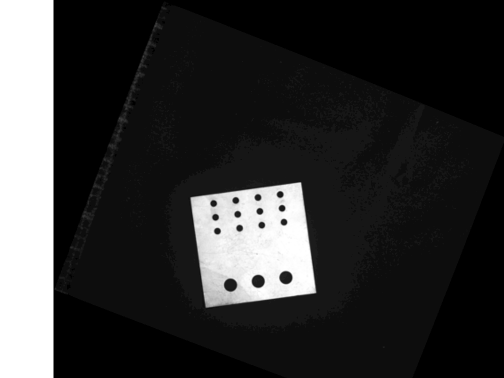
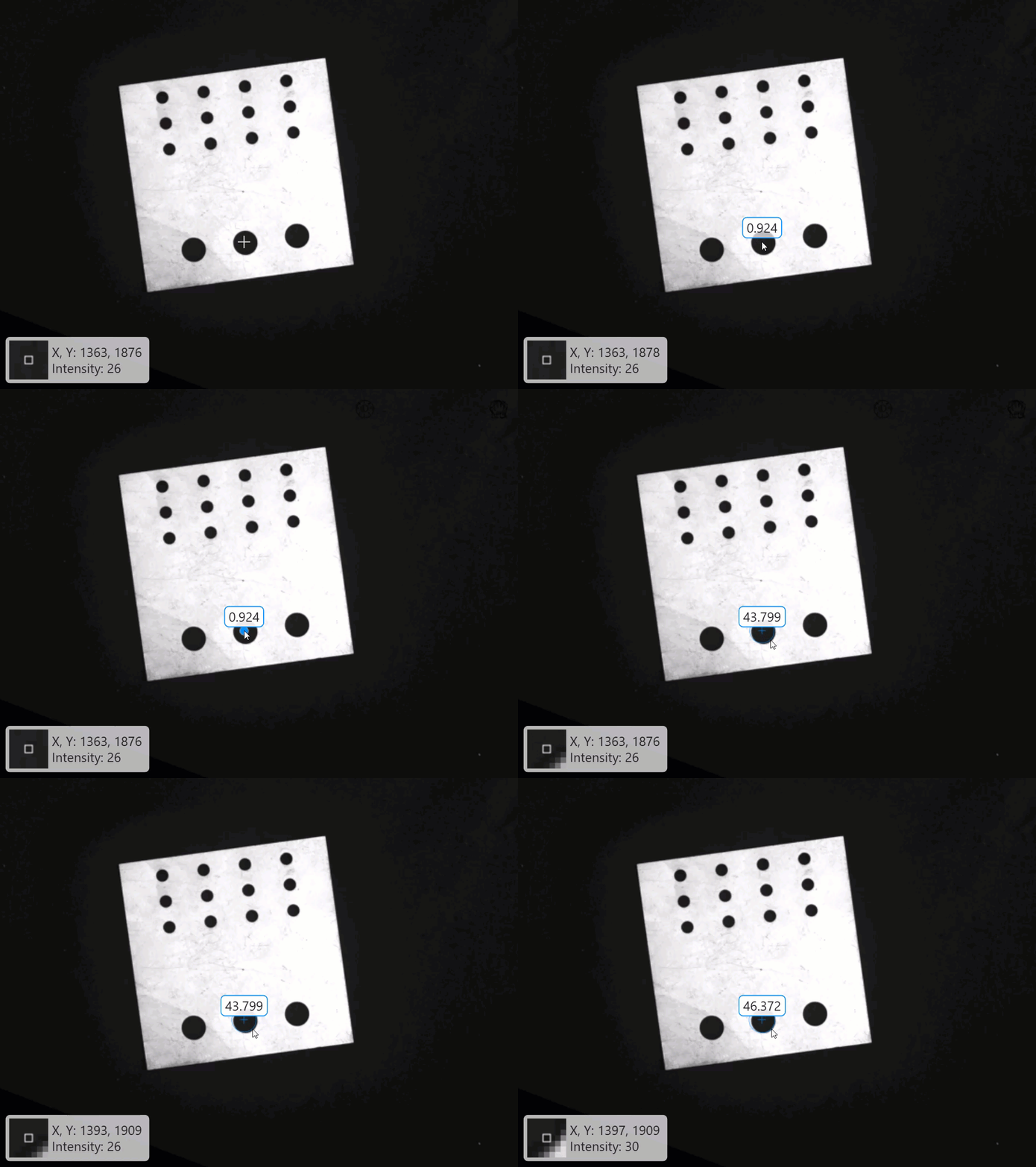
To interactively measure circles, configure the circle tool on the displayed image by using the uifitcircle object. Position the circle tool at the location of the circle center, and drag the tool outwards.
hCircle = uifitcircle(hIm);
This GIF shows how to interactively perform a circle measurement using the circle tool.
Version History
Introduced in R2026b
MATLAB Command
You clicked a link that corresponds to this MATLAB command:
Run the command by entering it in the MATLAB Command Window. Web browsers do not support MATLAB commands.
Web サイトの選択
Web サイトを選択すると、翻訳されたコンテンツにアクセスし、地域のイベントやサービスを確認できます。現在の位置情報に基づき、次のサイトの選択を推奨します:
また、以下のリストから Web サイトを選択することもできます。
最適なサイトパフォーマンスの取得方法
中国のサイト (中国語または英語) を選択することで、最適なサイトパフォーマンスが得られます。その他の国の MathWorks のサイトは、お客様の地域からのアクセスが最適化されていません。
南北アメリカ
- América Latina (Español)
- Canada (English)
- United States (English)
ヨーロッパ
- Belgium (English)
- Denmark (English)
- Deutschland (Deutsch)
- España (Español)
- Finland (English)
- France (Français)
- Ireland (English)
- Italia (Italiano)
- Luxembourg (English)
- Netherlands (English)
- Norway (English)
- Österreich (Deutsch)
- Portugal (English)
- Sweden (English)
- Switzerland
- United Kingdom (English)