fresnelCoefficients
Description
Add-On Required: This feature requires the Optical Design and Simulation Library for Image Processing Toolbox add-on.
specifies options for computing Fresnel coefficients using one or more name-value
arguments. For example, coeffs = fresnelCoefficients(oc,Name=Value)Wavelengths=300:10:800 specifies to
compute the Fresnel coefficients for wavelengths between 300 to 800 nanometers,
sampled 10 nanometers apart.
Examples
Create a broadband anti-reflective optical coating that contains two alternating TiO2/SiO2 layer stacks.
ocBBAR = opticalCoating(Name="BBAR_4l", ... CoatingMaterial = ["TiO2", "SiO2"], ... LayerMaterialIndex = [1 2 1 2], ... ThicknessUnit = "nm", ... LayerThickness = [14.6 36.5 129.1 95.5]);
Compute the Fresnel coefficients for the optical coating.
coeffs = fresnelCoefficients(ocBBAR);
Define the wavelength range.
lambda = ocBBAR.WavelengthRange(1):ocBBAR.WavelengthRange(2);
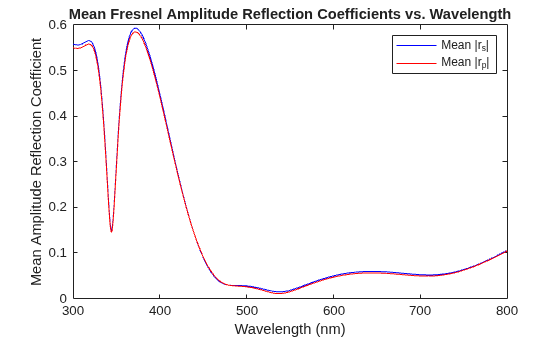
Plot the mean amplitude reflection coefficients for s- and p-polarization, rs and rp, respectively, as a function of the wavelength.
mean_rs = mean(abs(coeffs.rs),1); mean_rp = mean(abs(coeffs.rp),1); figure; plot(lambda,mean_rs,"b-",DisplayName="Mean |r_s|"); hold on; plot(lambda,mean_rp,"r-",DisplayName="Mean |r_p|"); xlabel("Wavelength (nm)"); ylabel("Mean Amplitude Reflection Coefficient"); legend show; title("Mean Fresnel Amplitude Reflection Coefficients vs. Wavelength"); hold off;
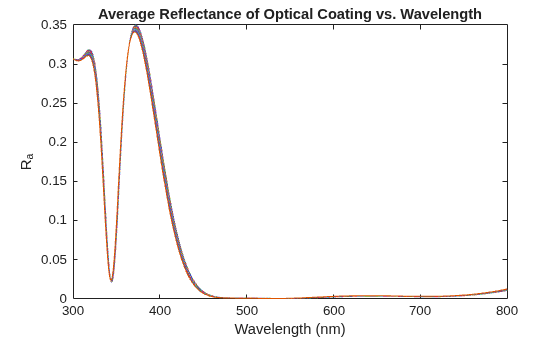
Plot the average reflectance as a function of the wavelength for all sampled incidence angles. By default, the sampled incident angle range is between 0 and 15 degrees.
plot(lambda,coeffs.Ra) xlabel("Wavelength (nm)") ylabel("R_a") title("Average Reflectance of Optical Coating vs. Wavelength")
Input Arguments
Optical coating, specified as an opticalCoating object.
Name-Value Arguments
Specify optional pairs of arguments as
Name1=Value1,...,NameN=ValueN, where Name is
the argument name and Value is the corresponding value.
Name-value arguments must appear after other arguments, but the order of the
pairs does not matter.
Example: fresnelCoefficients(Wavelengths=300:10:800) specifies to
compute the Fresnel coefficients for wavelengths between 300 to 800 nanometers, sampled
10 nanometers apart.
Wavelengths for which to compute Fresnel coefficients, specified as an
M-element numeric vector. M is the
number of wavelengths, and each element of the vector represents a wavelength,
in nanometers. By default, the Wavelengths value is the
wavelength range specified by
oc.WavelengthRange(1):oc.WavelengthRange(2).
Incident light angles for which to compute Fresnel coefficients, specified
as an N-element row vector. N is the
number of incident angles. The angles must be in the range [0, 90]. Units are
in degrees. If you do not specify the IncidentAngles
name-value argument, the function computes Fresnel coefficients at the incident
angles specified by the IncidentAngleRange property of the opticalCoating object oc.
Incident light direction with respect to the coating, specified as one of these options:
"medium2substrate"– Incoming incident light rays travel from the direction of the medium through the substrate."substrate2medium"– Incoming incident light rays travel from the direction of the substrate through the medium.
Output Arguments
Fresnel coefficients, returned as a structure containing these fields:
rs– Reflection amplitude coefficient, or complex ratio, for s-polarized incident light, stored as a N-by-M complex-valued matrix.rp– Reflection amplitude coefficient, or complex ratio, for p-polarized incident light, stored as a N-by-M complex-valued matrix.ts– Transmission amplitude coefficient, or complex ratio, for s-polarized incident light, stored as a N-by-M complex-valued matrix.tp– Transmission amplitude coefficient, or complex ratio, for p-polarized incident light, stored as a N-by-M complex-valued matrix.Rs– Reflection power coefficient, which signifies the reflectance, for s-polarized incident light, stored as a N-by-M matrix.Rp– Reflection power coefficient, which signifies the reflectance, for p-polarized incident light, stored as a N-by-M matrix.Ra– Average reflection power coefficient, stored as a N-by-M matrix. It is the average of the s-polarized and p-polarized power coefficients,RsandRp.Ts– Transmission power coefficient, which signifies the transmittance, for s-polarized incident light, stored as a N-by-M matrix.Tp– Transmission power coefficient, which signifies the transmittance, for p-polarized incident light, stored as a N-by-M matrix.Ta– Average transmission power coefficient, stored as a N-by-M matrix. It is the average of the s-polarized and p-polarized power coefficients,TsandTp.As- Absorbance coefficient for s-polarized incident light, stored as a N-by-M matrix.Ap- Absorbance coefficient for p-polarized incident light, stored as a N-by-M matrix.
N is the number of incident angles, and M is the number of wavelengths.
For s-polarized incident light, the electromagnetic field is in the plane perpendicular to the incident coating surface. For p-polarized incident light, the electromagnetic field is in the plane parallel to the incident coating surface.
Version History
Introduced in R2026a
MATLAB Command
You clicked a link that corresponds to this MATLAB command:
Run the command by entering it in the MATLAB Command Window. Web browsers do not support MATLAB commands.
Web サイトの選択
Web サイトを選択すると、翻訳されたコンテンツにアクセスし、地域のイベントやサービスを確認できます。現在の位置情報に基づき、次のサイトの選択を推奨します:
また、以下のリストから Web サイトを選択することもできます。
最適なサイトパフォーマンスの取得方法
中国のサイト (中国語または英語) を選択することで、最適なサイトパフォーマンスが得られます。その他の国の MathWorks のサイトは、お客様の地域からのアクセスが最適化されていません。
南北アメリカ
- América Latina (Español)
- Canada (English)
- United States (English)
ヨーロッパ
- Belgium (English)
- Denmark (English)
- Deutschland (Deutsch)
- España (Español)
- Finland (English)
- France (Français)
- Ireland (English)
- Italia (Italiano)
- Luxembourg (English)
- Netherlands (English)
- Norway (English)
- Österreich (Deutsch)
- Portugal (English)
- Sweden (English)
- Switzerland
- United Kingdom (English)