Mobile Ad Hoc Networks and Routing Protocols
R2026bA mobile ad hoc network (MANET) is a self-configuring wireless network that operates without fixed infrastructure. Mobile nodes operate in a distributed manner and communicate directly or through intermediate nodes. In a MANET, each node can act as a source, destination, and relay for data traffic, enabling multi-hop communication across the network.
MANETs support communication in environments where network infrastructure is unavailable, damaged, or impractical to deploy. Common applications include disaster response, search-and-rescue operations, and connectivity in remote locations.
In these scenarios, nodes might not always be in direct transmission range of one another. MANETs support multi-hop communication by enabling nodes that are out of transmission range to exchange data through intermediate nodes. Routing protocols enable all nodes to discover and maintain routing information. Using this information, intermediate nodes forward packets between source and destination nodes.
To maintain communication, nodes must continuously adapt to changes in network connectivity. The mobility of nodes changes the quality of wireless links and alters the network topology. These topology changes affect communication paths. Routing protocols must identify alternative routes when existing routes become unavailable.
This figure shows a MANET topology. The blue lines represent wireless links between neighboring nodes. The figure also illustrates a multi-hop route from node A to node E through nodes D and C. Nodes D and C forward packets along the route.
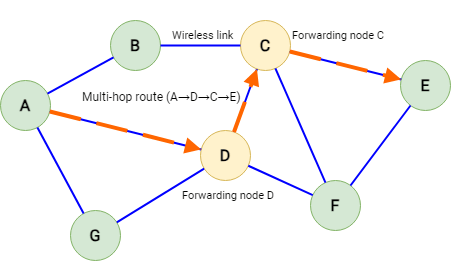
To establish and maintain these routes in a changing network topology, MANETs use reactive or proactive protocols. Reactive protocols, such as ad hoc on-demand distance vector (AODV) protocol, establish routes on demand. Proactive protocols, such as optimized link state routing (OLSR), maintain routes continuously.
Ad Hoc On-Demand Distance Vector Protocol
The AODV routing protocol is a reactive routing protocol. It establishes routes only when a node needs to send data. The AODV protocol initiates route discovery only when a node needs to send data to a destination, which reduces routing control overhead.
Route Discovery Mechanism
The AODV protocol starts the route discovery process when no valid route to the destination exists.
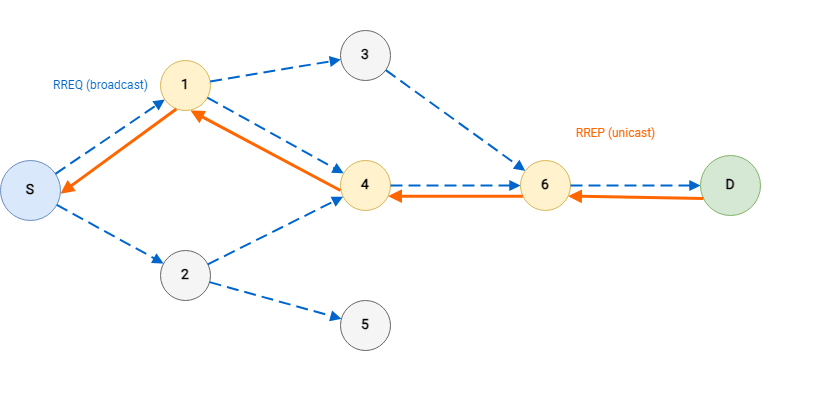
The source node broadcasts a route request (RREQ) message. Neighboring nodes receive the RREQ and rebroadcast it. The request moves hop by hop across the network.
As the RREQ moves through the network, each intermediate node creates or updates a reverse route to the source by recording the previous hop.
A node stops rebroadcasting the received RREQ when it is either the destination node or an intermediate node with a valid route to the destination.
The destination node or intermediate node then generates a route reply (RREP) message and sends it back to the source along the reverse route, which consists of the nodes that forwarded the RREQ.
This figure shows AODV route discovery. The source broadcasts a RREQ. The destination or an intermediate node returns a RREP along the reverse route.
This process:
Builds a path from the source to the destination.
Chooses fresh routes, that is, the most up-to-date route information, by using sequence numbers.
Keeps routes loop-free by following sequence number rules.
Route Maintenance
Node mobility can cause existing routes to break. AODV maintains routes by detecting route failures and discovering replacement routes.
When a node attempts to forward a data packet and detects that the next hop is no longer reachable, it generates an RERR message. A node can also generate an RERR after receiving an RERR from another node. The RERR informs upstream nodes that one or more destinations have become unreachable.
In this figure, the node that detects the route failure sends an RERR message to the affected upstream nodes. These nodes invalidate the corresponding route entries and stop using them.
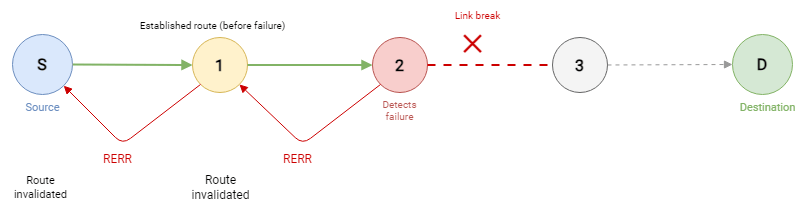
The data packets travel from the source node to node 1 and then to node 2. For node 2, node 3 is the next hop toward the destination. When node 2 detects that node 3 is no longer reachable, it cannot continue forwarding packets toward the destination. Node 2 then generates an RERR message and sends it to node 1. After receiving the RERR, node 1 forwards the message to the source node, informing the source that the route has broken.
AODV associates each route with a lifetime value. When nodes actively use a route, they refresh its lifetime. When the lifetime expires, nodes mark the route as invalid and later remove the route entry from the routing table if no valid replacement exists.
Route rediscovery can introduce additional packet delivery delay.
Sequence Numbers and Loop Prevention
To judge route freshness and prevent loops, the AODV protocol uses destination sequence numbers
Nodes update their own sequence numbers only under specific conditions. For example, a node increments its sequence number before initiating route discovery. Before generating an RREP, a destination node updates its sequence number to the maximum of its current sequence number and the destination sequence number contained in the RREQ.
When a node receives an RREP, it compares the destination sequence number in the RREP with the destination sequence number stored in its routing table for that destination. If the RREP contains a higher destination sequence number, the node updates the route because the RREP provides the most recent routing information. If both destination sequence numbers are equal, the node prefers the route with the lower hop count.
Advantages and Disadvantages
The advantages of the AODV protocol are:
It reduces control overhead because it establishes routes only when required.
It scales well in dynamic networks.
The disadvantages of the AODV protocol are:
Because the source node discovers routes before sending the data, the protocol adds an initial delay
Because routes break and reform often, this protocol creates more overhead in highly mobile networks
For an example of how to simulate a time division multiple access (TDMA) MANET by using the AODV routing protocol, see AODV Routing in TDMA-Based MANET. For more information about AODV, see RFC 3561 [1].
Optimized Link State Routing Protocol
The OLSR protocol is a proactive routing protocol. It maintains routing information continuously so that routes remain available when nodes need to send data. Unlike AODV, OLSR does not perform route discovery before forwarding data packets. Instead, nodes exchange routing information periodically and maintain up-to-date routing tables.
Because routes are already available, a node can send the first data packet without waiting for a route discovery process.
Link-State Routing Approach
The OLSR protocol uses multipoint relays (MPRs) to perform controlled flooding, which reduces redundant retransmissions while maintaining network-wide topology dissemination.
Nodes exchange HELLO and topology control messages at regular intervals:
HELLO messages allow a node to discover one-hop neighbors, identify symmetric links, obtain two-hop neighbor information, and select MPRs.
Topology control (TC) messages spread topology information across the network.
Each node uses the collected topology information to compute routes to other nodes. The OLSR protocol computes routes by applying a shortest-path algorithm and selecting the route with the lowest path cost. Different OLSR implementations can define the path cost by using various routing metrics, such as latency or hop count. In the Simulate OLSR-based MANET for Emergency Response Scenario example, the OLSR protocol selects the route with the minimum number of hops.
Multipoint Relay Optimization
In traditional flooding, every node retransmits each broadcast message, which creates many duplicate transmissions. The OLSR protocol reduces this overhead by selecting specific nodes to retransmit broadcast control messages.
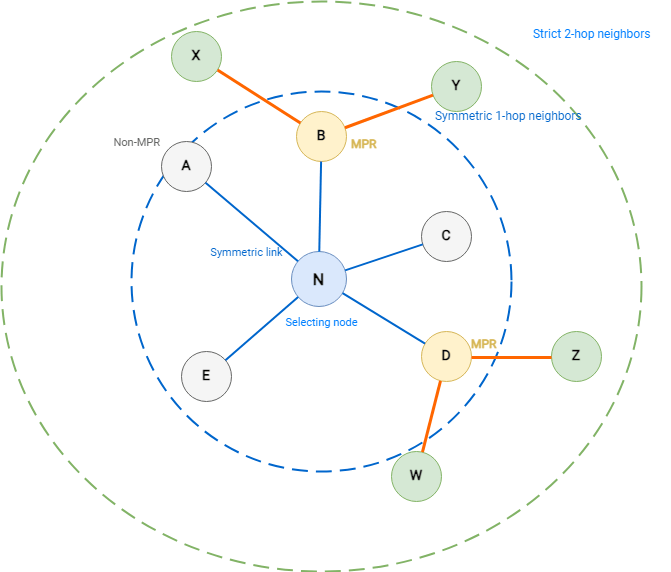
Each node selects a minimal subset of its symmetric one-hop neighbors as MPRs such that all of its strict symmetric two-hop neighbors can be reached via the selected MPRs. A strict two-hop neighbor is a node that is reachable in exactly two hops but is not a direct one-hop neighbor. This figure demonstrates how the MPR subset covers all strict two-hop neighbors.
The MPR mechanism consists of these operations:
Each node identifies its one-hop and two-hop neighbors.
The node selects a minimal set of one-hop neighbors as MPRs to cover all strict symmetric two-hop neighbors.
The MPR nodes generate topology control (TC) messages. When a node receives a TC message, it rebroadcasts the message only if it is an MPR node.
This controlled flooding mechanism reduces duplicate retransmissions and lowers flooding overhead.
Route Computation
Each node computes its own routing table by using:
Local link information
Neighbor information
Two-hop neighbor information
Topology information from TC messages
Each node then runs a shortest-path computation and selects the routes with the minimum hop count to known destinations.
Advantages and Disadvantages
The advantages of the OLSR protocol are:
It eliminates route discovery delay before transmitting data.
It maintains routes continuously for active communication.
It reduces flooding overhead through the MPR mechanism.
It works well in dense networks where MPRs significantly reduce redundant retransmissions.
Because nodes exchange periodic routing information even when little or no data traffic exists, the OLSR protocol creates additional control overhead.
Although MPRs significantly reduce flooding overhead, OLSR still incurs the cost of continuously maintaining routing information for the network.
For an example of how to simulate a TDMA-based MANET that uses the OLSR protocol, see Simulate OLSR-based MANET for Emergency Response Scenario. For more information about OLSR, see RFC 3626 [2].
References
[1] RFC 3561. "Ad hoc On-Demand Distance Vector (AODV) Routing." Internet Engineering Task Force (IETF)
[2] RFC 3626. "Optimized Link State Routing Protocol (OLSR)." Internet Engineering Task Force (IETF)

