SM PSS2C
Discrete- or continuous-time double-input PSS2C, PSS2B, or PSS2A power system stabilizer
Libraries:
Simscape /
Electrical /
Control /
SM Control
Description
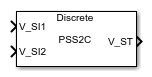
The SM PSS2C block implements a double-input PSS2C power system stabilizer (PSS) that maintains rotor angle stability in a synchronous machine (SM) in conformance with IEEE Std 421.5-2016 [1]. You can also use the SM PSS2C block to implement a PSS2B model or PSS2A model from previous versions of IEEE Std 421.5 [2-3]. For more information about implementing these models, see PSS2B Model or PSS2A Model. Typically, you use a PSS to enhance the damping of power system oscillations through excitation control.
You can represent two different types of dual-input power system stabilizers with this same model:
A stabilizer that uses electrical power and speed (or frequency) signals to calculate the integral of the accelerating power. This makes the calculated stabilizer signal insensitive to mechanical changes.
A stabilizer that uses a combination of electrical power and either speed or frequency. To achieve the desired stabilizing signal shaping, the system uses the speed directly, without phase-lead compensation, and adds a signal that is proportional to the electrical power.
You can switch between continuous and discrete implementations of the block by using the
Sample time (-1 for inherited) parameter. To configure the
integrator for continuous time, set the Sample time (-1 for
inherited) property to 0. To configure the integrator
for discrete time, set the Sample time (-1 for inherited) property
to a positive, nonzero value, or to -1 to inherit the sample time
from an upstream block.
This diagram illustrates the overall structure of the PSS2C power system stabilizer:

In the diagram:
V_SI1 and V_SI2 are the two power system stabilizer inputs. Commonly used inputs are speed, frequency, or power.
Two Washout (Discrete or Continuous) blocks are represented for each stabilizer input, with time constants TW1 to TW4, along with a transducer, represented by a Low-Pass Filter (Discrete or Continuous), with time constants T6 and T7.
To allow a ramp-tracking filter characteristic, the Ramp Tracking Filter subsystem models a network of lead-lag and low-pass filter blocks in series.
To provide phase compensation, a Lead-Lag (Discrete or Continuous) network models additional dynamics associated with the power system stabilizer, representing four stages of lead-lag compensation, with time constants T1 to T4 and T10 to T13.
The PSS output logic subsystem allows the representation of the PSS output logic associated with the generator active power output. PPSSon and PPSSoff are the threshold values used to define a hysteresis.
PSS2B Model
You can represent existing PSS2B models using the PSS2C model. The PSS2C model introduced the fourth lead-lag block to the PSS2B model. You can effectively bypass lead-lag blocks by setting the lead and lag time constants to the same value. To implement a PSS2B model using the SM PSS2C block, set the value of the PSS denominator (lead) compensating time constant (fourth block), T_12 (s) equal to the value of the PSS denominator (lag) compensating time constant (fourth block), T_13 (s) parameter.
PSS2A Model
You can represent existing PSS2A models using the PSS2C model. The PSS2B and PSS2C models introduced the third and fourth lead-lag blocks to the PSS2A model, respectively. You can effectively bypass lead-lag blocks by setting the lead and lag time constants to the same value. To implement a PSS2B model using the SM PSS2C block:
Set the value of the PSS denominator (lead) compensating time constant (third block), T_10 (s) parameter equal to the value of the PSS denominator (lag) compensating time constant (third block), T_13 (s) parameter.
Set the value of the PSS denominator (lead) compensating time constant (fourth block), T_12 (s) parameter equal to the value of the PSS denominator (lag) compensating time constant (fourth block), T_13 (s) parameter.
Ports
Input
Output
Parameters
References
[1] “IEEE Recommended Practice for Excitation System Models for Power System Stability Studies.” IEEE Std 421.5-2016 (Revision of IEEE Std 421.5-2005), August 2016, 1–207. https://doi.org/10.1109/IEEESTD.2016.7553421.
[2] “IEEE Recommended Practice for Excitation System Models for Power System Stability Studies.” IEEE Std 421.5-2005 (Revision of IEEE Std 421.5-1992), April 2006, 1–93. https://doi.org/10.1109/IEEESTD.2006.99499.
[3] “IEEE Recommended Practice for Excitation System Models for Power System Stability Studies.” IEEE Std 421.5-1992, August 1992, 1–56. https://doi.org/10.1109/IEEESTD.1992.106975.
Extended Capabilities
Version History
Introduced in R2020a

