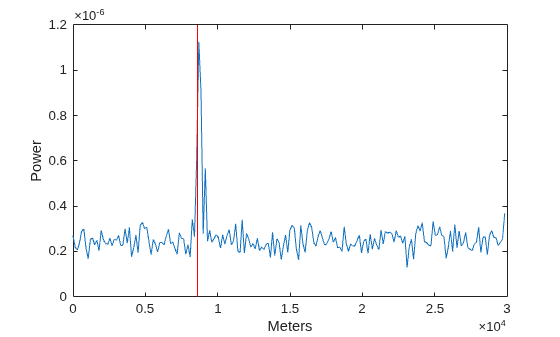
位相符号化波形を使用した基本的なレーダー
R2026bSignal Simulationの例で使用されている矩形波形の代わりに、位相符号化波形を使用できます。これを行うには、phased.RectangularWaveform System object™ を phased.PhaseCodedWaveform に置き換えます。
waveform = phased.PhaseCodedWaveform('Code','Frank','NumChips',4,...
    'ChipWidth',1e-6,'PRF',5e3,'OutputFormat','Pulses',...
    'NumPulses',1);
次に、新しい波形のプロパティを使用して、パルス幅 tau を再定義します。
tau = waveform.ChipWidth*waveform.NumChips;
コードの残りの部分は元の例のコードとほぼ同じであり、ここではコメントなしで示されています。コードの動作の詳細な説明については、元のSignal Simulationの例を参照してください。
antenna = phased.IsotropicAntennaElement('FrequencyRange',[1e9 10e9]);
target = phased.RadarTarget('Model','Nonfluctuating',...
    'MeanRCS',0.5,'PropagationSpeed',physconst('LightSpeed'),...
    'OperatingFrequency',4e9);
transmitterplatform = phased.Platform('InitialPosition',[0;0;0],...
    'Velocity',[0;0;0]);
targetplatform = phased.Platform('InitialPosition',[7000; 5000; 0],...
    'Velocity',[-15;-10;0]);
[tgtrng,tgtang] = rangeangle(targetplatform.InitialPosition,...
    transmitterplatform.InitialPosition);

% Use the radar equation to compute the transmitted power needed for a given Pd and Pfa.
numpulses = 10;
Pd = 0.9;
Pfa = 1e-6;
maxrange = 1.5e4;
lambda = physconst('LightSpeed')/target.OperatingFrequency;
RCS = 0.5;
Ts = 290;
SNR = albersheim(Pd,Pfa,10);
Gain = 20;
dbterms = db2pow(SNR - 2*Gain);
Pt = (4*pi)^3*physconst('Boltzmann')*Ts/tau/RCS/(lambda^2)*maxrange^4*dbterms;

transmitter = phased.Transmitter('PeakPower',50e3,'Gain',20,...
    'LossFactor',0,'InUseOutputPort',true,...
    'CoherentOnTransmit',true);
radiator = phased.Radiator('Sensor',antenna,...
    'PropagationSpeed',physconst('LightSpeed'),...
    'OperatingFrequency',4e9);
collector = phased.Collector('Sensor',antenna,...
    'PropagationSpeed',physconst('LightSpeed'),...
    'Wavefront','Plane','OperatingFrequency',4e9);
receiver = phased.ReceiverPreamp('Gain',20,'NoiseFigure',2,...
    'ReferenceTemperature',290,'SampleRate',1e6,...
    'EnableInputPort',true,'SeedSource','Property','Seed',1e3);
channel = phased.FreeSpace(...
    'PropagationSpeed',physconst('LightSpeed'),...
    'OperatingFrequency',4e9,'TwoWayPropagation',false,...
    'SampleRate',1e6);
T = 1/waveform.PRF;
txpos = transmitterplatform.InitialPosition;
rxsig = zeros(waveform.SampleRate*T,numpulses);
for n = 1:numpulses
    [tgtpos,tgtvel] = targetplatform(T);
    [tgtrng,tgtang] = rangeangle(tgtpos,txpos);
    sig = waveform();
    [sig,txstatus] = transmitter(sig);
    sig = radiator(sig,tgtang);
    sig = channel(sig,txpos,tgtpos,[0;0;0],tgtvel);
    sig = target(sig);
    sig = channel(sig,tgtpos,txpos,tgtvel,[0;0;0]);
    sig = collector(sig,tgtang);
    rxsig(:,n) = receiver(sig,~txstatus);
end
rxsig = pulsint(rxsig,'noncoherent');
t = unigrid(0,1/receiver.SampleRate,T,'[)');
rangegates = (physconst('LightSpeed')*t)/2;
plot(rangegates,rxsig)
hold on
xlabel('Meters'); ylabel('Power')
ylim = get(gca,'YLim');
plot([tgtrng,tgtrng],[0 ylim(2)],'r')
hold off