speechIntelligibilityIndex
R2026bMeasure speech audibility using speech intelligibility index (SII) metric
Since R2026b
Syntax
Description
specifies options using one or more name-value arguments, such as the filter bank
method. Some name-value arguments are required for specific SII calculations. For more
information, see Speech Intelligibility Index Input Arguments.[___] = speechIntelligibilityIndex(___,Name=Value)
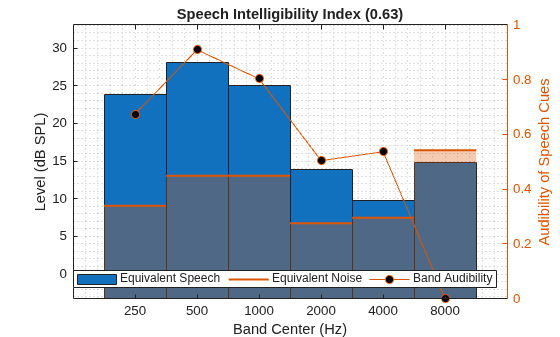
speechIntelligibilityIndex(___) without any output
arguments plots a bar chart of equivalent speech and noise levels per band, overlaid
with the BAF.
Examples
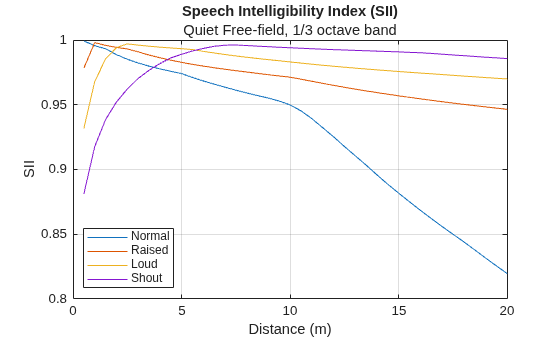
Create a vector of distances from 0.5–20 m at increments of 0.5 m.
d = 0.5:0.5:20;
Calculate the SII for each vocal effort and each distance. Use the default speech and noise profiles for 1/3 octave bands.
sii = nan(4,numel(d)); for ii = 1:numel(d) sii(1,ii) = speechIntelligibilityIndex( ... Method="1/3 octave band", ... VocalEffort="normal", ... Distance=d(ii)); sii(2,ii) = speechIntelligibilityIndex( ... Method="1/3 octave band", ... VocalEffort="raised", ... Distance=d(ii)); sii(3,ii) = speechIntelligibilityIndex( ... Method="1/3 octave band", ... VocalEffort="loud", ... Distance=d(ii)); sii(4,ii) = speechIntelligibilityIndex( ... Method="1/3 octave band", ... VocalEffort="shout", ... Distance=d(ii)); end
Plot the SII for each vocal effort as a function of distance between speaker and listener.
plot(d,sii) grid on title("Speech Intelligibility Index (SII)","Quiet Free-field, 1/3 octave band") xlabel('Distance (m)') ylabel('SII') legend('Normal','Raised','Loud','Shout',Location="SouthWest")
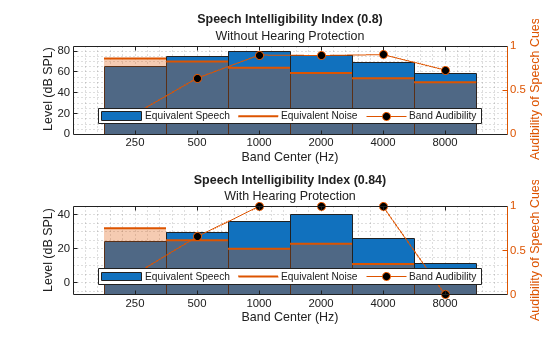
Investigate the effect of ear devices on the speech intelligibility index.
Define octave-band center frequencies and typical attenuation in dB SPL for foam earplugs.
freq = [250,500,1000,2000,4000,8000]; attenuation = [41,45,44,36,43,47];
Compare the SII for shouting speech levels in a loud environment with and without hearing protection.
noiseSpectrum = [73 70 64 59 54 50]; figure tiledlayout(2,1,TileSpacing="compact") nexttile speechIntelligibilityIndex(NoiseLevel=noiseSpectrum,... VocalEffort="shout") subtitle("Without Hearing Protection") nexttile speechIntelligibilityIndex(NoiseLevel=noiseSpectrum,... VocalEffort="shout",... InsertionGain=-attenuation) subtitle("With Hearing Protection")
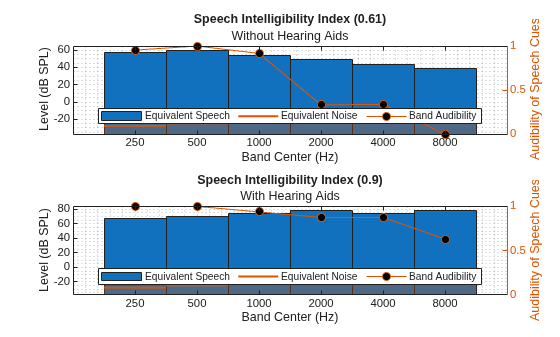
Define the typical hearing loss in dB HL for adults aged 60–69 and octave band gain in dB SPL for hearing aids.
hearingLoss = [25,25,25,40,40,40]; aidGain = [10,10,20,30,30,40];
Compare the SII for normal speech and noise levels without and with hearing aids.
figure tiledlayout(2,1,TileSpacing="compact") nexttile speechIntelligibilityIndex(HearingThreshold = hearingLoss) subtitle("Without Hearing Aids") nexttile speechIntelligibilityIndex(HearingThreshold = hearingLoss,... InsertionGain=aidGain) subtitle("With Hearing Aids")
Calculate the SII from room impulse response simulations using the methods in clause 5.2 of the ANSI/ASA S3.5-1997 standard.
Read a recording of a washing machine to simulate background noise in a space. Calculate the length of the recording in seconds.
[noise,fs] = audioread("Engine-16-44p1-stereo-20sec.wav"); noise = mean(noise,2); % convert to mono duration = numel(noise)/fs; % seconds
Generate two room impulse responses of a shoebox room using acousticRoomResponse. The responses simulate measurements at the center of a listener's head. Generate the first response from the location of a speaker (1 m from the listener) and the second response from the location of the noise source (3 m from the listener).
room = [4, 6, 6]; % meters
headLoc = [2, 2.5, 1.75];
speakerLoc = [2, 3.5, 1.75];
noiseLoc = [2, 5.5, 1.75];
irSpeaker = acousticRoomResponse(room,speakerLoc,headLoc,SampleRate=fs);
irNoise = acousticRoomResponse(room,noiseLoc,headLoc,SampleRate=fs);Convolve the noise signal with the impulse response generated from the noise source location. Measure the equivalent continuous sound level (Leq) of the noise in the room using splMeter. This example treats the noise signal as if it was recorded using a calibrated microphone. For real measurements, use a signal recorded with a calibrated microphone or provide a calibration factor when creating the splMeter object.
noiseInRoom = fftfilt(irNoise,noise); meter = splMeter(SampleRate=fs,... FrequencyWeighting="Z-weighting",... Bandwidth="1 octave",... FrequencyRange=[250,8000],... TimeInterval=duration); [~,noiseLeq] = meter(noiseInRoom); noiseLeq = noiseLeq(end,:); % use final reading
Generate a speech spectrum excitation signal with the same duration as the audio recording using siiExcitation. To simulate a calibrated real-world excitation, set Normalize to false.
[~,speechExcitation] = siiExcitation(fs, ... Method="octave band", ... Duration=duration, ... VocalEffort="shout", ... Normalize=false, ... OutputMode="merged");
Convolve the speech excitation with the impulse response generated from the speaker location. Combine the noise and filtered speech signal and measure the combined speech and noise level (CSNSL).
speechInRoom = fftfilt(irSpeaker,speechExcitation);
speechAndNoise = speechInRoom+noiseInRoom;
release(meter);
[~,csnsl] = meter(speechAndNoise);
csnsl = csnsl(end,:); % use final readingCalculate the speech intelligibility index using the simulated impulse response from the speaker location, CSNSL, and noise levels.
speechIntelligibilityIndex(irSpeaker,fs, ... SpeechAndNoiseLevel=csnsl, ... NoiseLevel=noiseLeq)
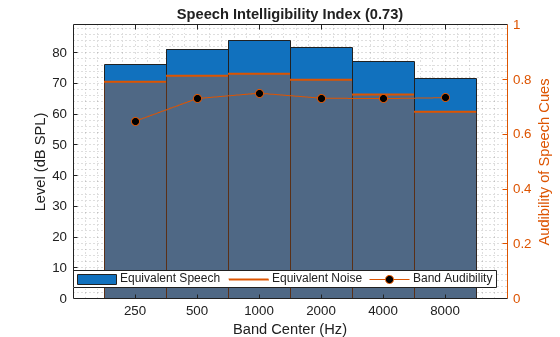
Calculate the SII from recordings made at the eardrum using the methods in clause 5.3 of the ANSI/ASA S3.5-1997 standard.
Use sofaread to load a Spatially Oriented Format for Acoustics (SOFA) file with generic head-related impulse responses (HRIRs). Choose the index that corresponds to a source directly in front of the listener.
s = sofaread("ReferenceHRTF.sofa"); mIndex = 7; fprintf("Azimuth: %0.f. Elevation: %0.f. Radius: %0.f.\n",s.SourcePosition(mIndex,:));
Azimuth: 0. Elevation: 0. Radius: 4.
Get the HRIR at the selected position for the left ear and the sample rate of the HRIR.
fs = s.SamplingRate; hrir = squeeze(s.Numerator(mIndex,1,:));
Generate the SII excitation signals with siiExcitation. To simulate a calibrated real-world excitation, set Normalize to false.
duration = 16; [mtfExcitation,speechExcitation,levels] = siiExcitation(fs, ... Method="octave band", ... Duration=duration, ... Normalize=false, ... OutputMode="merged");
Use pink noise to simulate a noise source. Convolve the speech excitation and noise signal with the HRIR. Combine the noise and filtered speech signal and measure the combined speech and noise level (CSNSL).
noise = 0.25*pinknoise(duration*fs); speechAndNoise = fftfilt(hrir,speechExcitation+noise);
Use splMeter to measure the CSNSL.
meter = splMeter(SampleRate=fs,... FrequencyWeighting="Z-weighting",... Bandwidth="1 octave",... FrequencyRange=[250,8000],... TimeInterval=duration); [~,csnsl] = meter(speechAndNoise); csnsl = csnsl(end,:); % use final reading
Convolve the MTF excitation and noise signals with the HRIR to generate the system response.
mtfResponse = fftfilt(hrir,mtfExcitation+noise);
Use the excitation and response signals to calculate the SII. Set SpeechMeasurementLocation and NoiseMeasurementLocation to "eardrum" to indicate that measurements were taken in-ear.
speechIntelligibilityIndex(mtfResponse,mtfExcitation,fs, ... SpeechAndNoiseLevel=csnsl, ... Method="octave band",... SpeechMeasurementLocation="eardrum", ... NoiseMeasurementLocation="eardrum")
Input Arguments
Impulse response, specified as a numeric vector. When you specify
ir, you must also specify fs. If background
noise was present during the impulse response measurement, specify NoiseLevel to account for the noise contribution.
The impulse response must be recorded under specific conditions for the SII to be standard-compliant in certain environments. For more information, see Speech Intelligibility Index Input Arguments and Measurement Locations.
Data Types: single | double
Received signals used to compute the modulation transfer function, specified as an N-by-9 matrix or an N-by-9-by-B array where N is the number of samples, 9 corresponds to the modulation frequencies (0.5, 1, 1.5, 2, 3, 4, 6, 8, and 16 Hz), and B is the number of frequency bands.
When you specify processed, you must also specify
reference and fs. The signals
in reference can be generated using the siiExcitation function. The
signals in processed correspond to the signals specified by
reference after they are processed by the analyzed
acoustic system. processed must have the same dimensions as
reference.
The processed signals must be recorded under specific conditions for the SII to be standard-compliant in certain environments. For more information, see Speech Intelligibility Index Input Arguments and Measurement Locations.
Data Types: single | double
Transmitted signals used to compute the modulation transfer function, specified as an N-by-9 matrix or an N-by-9-by-B array where N is the number of samples, 9 corresponds to the modulation frequencies (0.5, 1, 1.5, 2, 3, 4, 6, 8, and 16 Hz), and B is the number of frequency bands.
Generate reference using the siiExcitation function.
Specify OutputMode as
"merged" to sum the outputs of each band into one signal for
each modulation frequency, creating an N-by-9 matrix. Specify
OutputMode as "full" to keep the output
signals for each band separate, creating an
N-by-9-by-B array.
When you specify reference, you must also specify
processed and fs.
reference must have the same dimensions as
processed.
Data Types: single | double
Sample rate in Hz, specified as a positive scalar. The minimum recommended
sample rate is 16 kHz for the equally-contributing critical band method and 22.05
kHz for the critical band, one-third octave-band, and octave-band methods. You
must specify fs when you specify either ir or processed and reference.
Data Types: single | double
Name-Value Arguments
Specify optional pairs of arguments as
Name1=Value1,...,NameN=ValueN, where Name is
the argument name and Value is the corresponding value.
Name-value arguments must appear after other arguments, but the order of the
pairs does not matter.
Example: sii = speechIntelligibilityIndex(ir,fs,Method="critical
band")
Filter bank procedure used in the SII computation, specified as one of the
listed values. If you do not specify Method, the function
infers the method from the size of band-dependent input arguments, or defaults
to "1/3 octave band" if you do not provide band-dependent
arguments.
Method determines the number of frequency bands and the
computational accuracy. The methods in descending order of accuracy and number
of bands are:
Critical band (21 bands)
One-third octave band (18 bands)
Equally-contributing critical band (17 bands)
Octave band (6 bands)
The standard recommends against using octave bands when the speech or noise levels vary greatly within one octave [1].
Data Types: char | string
Speech level, specified as "standard",
"idealized", a numeric 1-by-B vector
in dB SPL where B is the number of bands, or a numeric
scalar representing the overall sound pressure level in dB OASPL. When you
specify "standard", speechIntelligibilityIndex uses
tabulated speech levels from the standard [1]. When you
specify "idealized", the function uses a flat 35 dB spectrum
up to 500 Hz, decreasing at 9 dB/octave above 500 Hz, adjusted for vocal effort
(see VocalEffort).
Specify a numeric vector to use custom per-band speech levels. If you
specify a numeric scalar, the function interprets the level as the overall
sound pressure level (OASPL). In this case, speechIntelligibilityIndex
selects the standard speech spectrum adjusted for
VocalEffort and adjusts band levels so that the OASPL
is equal to SpeechLevel.
speechIntelligibilityIndex errors if you specify
SpeechLevel and any of ir, processed, reference, or fs.
SpeechLevel is mutually exclusive with
VocalEffort when specified as a vector and mutually
exclusive with Distance when specified as a vector or numeric scalar.
Data Types: char | string | single | double
Noise level, specified as a numeric 1-by-B vector in dB SPL where B is the number of bands, or a numeric scalar in dB OASPL.
When you do not specify input signals, the function uses
NoiseLevel with SpeechLevel to compute
the SII. When you specify ir,
NoiseLevel serves as a correction factor for background
noise present during measurement. When you specify processed and
reference, speechIntelligibilityIndex uses
NoiseLevel as a correction factor only when SpeechAndNoiseLevel is
unspecified or a scalar value. The function errors if you specify
NoiseLevel and also specify
processed, reference, and
SpeechAndNoiseLevel as a vector.
If you do not specify NoiseLevel,
speechIntelligibilityIndex uses a noise profile of –50 dB/Hz in each
band. If you specify a numeric scalar, the function interprets the level as the
OASPL and distributes the power evenly among all bands. This behavior might
cause the calculated SII to be non-compliant with the standard. For standard
compliance, specify a numeric vector.
Data Types: single | double
Combined speech and noise level, specified as a numeric 1-by-B vector in dB SPL where B is the number of bands, or a numeric scalar in dB OASPL. This argument represents the time-mean-square sum of the combined speech and noise levels.
If you do not specify SpeechAndNoiseLevel,
speechIntelligibilityIndex uses a standard speech spectrum profile
with a noise profile of –50 dB/Hz in each band. If you specify a numeric
scalar, the level represents the OASPL and might cause the calculated SII to be
non-compliant with the standard. For standard compliance, specify a numeric
vector.
If you specify SpeechAndNoiseLevel, you must also
specify ir or
processed and
reference.
Data Types: single | double
Distance between talker and listener in meters, specified as a positive
scalar. speechIntelligibilityIndex uses Distance to
derive the equivalent speech level from the standard speech spectrum using the
inverse square law propagation model.
speechIntelligibilityIndex errors if you specify
Distance and any of ir, processed, reference, or fs.
Distance is mutually exclusive with SpeechLevel specified as a numeric scalar or vector.
Data Types: single | double
Speech vocal effort, specified as one of the listed values.
speechIntelligibilityIndex maps VocalEffort to
speech levels from the standard [1] using the
values shown in the table. The overall speech level determines the per-band
speech level using Tables 1–4 from the standard, depending on the value of
Method.
VocalEffort value | Speech Levels |
|---|---|
"normal" | Speech levels corresponding to an overall speech level of 62.35 dB SPL |
"raised" | Speech levels corresponding to an overall speech level of 68.34 dB SPL |
"loud" | Speech levels corresponding to an overall speech level of 74.85 dB SPL |
"shout" | Speech levels corresponding to an overall speech level of 82.30 dB SPL |
"raised-approximate" | Speech levels corresponding to "normal" with
each band increased by 7.8 dB |
"loud-approximate" | Speech levels corresponding to "normal" with
each band increased by 15.6 dB |
"shout-approximate" | Speech levels corresponding to "normal" with
each band increased by 23.4 dB |
speechIntelligibilityIndex errors if you specify
VocalEffort and any of ir, processed, reference, or fs.
VocalEffort is mutually exclusive with SpeechLevel specified as a vector.
Data Types: char | string
Device insertion gain in dB SPL, specified as a scalar or
1-by-B row vector, where B is the
number of bands. Use insertion gain to model the effect of in-ear devices such
as hearing aids or ear protectors. If you specify
InsertionGain as a scalar,
speechIntelligibilityIndex applies the value uniformly across all
bands. The default value is 0 dB per band, indicating no insertion gain.
Data Types: single | double
Hearing threshold level in dB HL, specified as a nonnegative scalar or
nonnegative 1-by-B row vector, where B is
the number of bands. If you specify HearingThresholdLevel
as a scalar, speechIntelligibilityIndex applies the value uniformly
across all bands.
Use HearingThresholdLevel to model the total hearing
threshold elevation for all causes of hearing loss. The default value is 0 dB
HL in all bands, corresponding to otologically normal hearing thresholds for
listeners aged 18-30. Specify both HearingThresholdLevel
and ConductiveHearingLossLevel to model the effects of conductive
hearing loss. The value of HearingThresholdLevel must be
greater than or equal to ConductiveHearingLossLevel in
each band.
Data Types: single | double
Conductive hearing loss in dB HL, specified as a nonnegative scalar or
nonnegative 1-by-B row vector, where B is
the number of bands. If you specify
ConductiveHearingLossLevel as a scalar,
speechIntelligibilityIndex applies the value uniformly across all
bands.
Use conductive hearing loss levels to model additional attenuation from the
outer or middle ear. When you do not specify
ConductiveHearingLossLevel,
speechIntelligibilityIndex assumes no conductive loss. The value of
ConductiveHearingLossLevel must not exceed the
HearingThresholdLevel in each band.
Data Types: single | double
Band importance function used to weight band audibility values in the SII calculation, specified as one of the listed string values or a nonnegative 1-by-B vector, where B is the number of bands.
When you specify BandImportanceFunction as a string
value, speechIntelligibilityIndex selects the corresponding importance
function derived from Tables 1–4 and B.1–B.3 of the standard [1]. A numeric
vector must contain at least one nonzero value. The function automatically
normalizes custom numeric vectors so that the sum equals 1. The default value
is the standard band importance function from Tables 1–4 of the standard,
depending on the value of Method. For more
information, see Band Importance Function and Band Audibility Function.
Data Types: char | string | single | double
Speech measurement location, specified as "free-field" or
"eardrum". When you specify
SpeechMeasurementLocation as
"eardrum", speechIntelligibilityIndex applies the
inverse free-field-to-eardrum transfer function to the speech levels. For more
information, see Speech Intelligibility Index Input Arguments and Measurement Locations.
If you specify SpeechMeasurementLocation as
"eardrum", the following conditions apply:
If you specify either
irorprocessedandreference, you must also specifySpeechAndNoiseLevel.For most workflows, set
SpeechMeasurementLocationandNoiseMeasurementLocationto the same value.speechIntelligibilityIndexdoes not enforce this constraint.If you do not specify any of
ir,processedorreference, you must specifySpeechLevelas a numeric scalar or vector.
Data Types: char | string
Noise measurement location, specified as "free-field" or
"eardrum". When you specify
NoiseMeasurementLocation as
"eardrum", speechIntelligibilityIndex applies the
inverse free-field-to-eardrum transfer function to the noise levels. For more
information, see Speech Intelligibility Index Input Arguments and Measurement Locations.
If you specify NoiseMeasurementLocation as
"eardrum", the following conditions apply:
If you specify either
irorprocessedandreference, you must also specifySpeechAndNoiseLevel.For most workflows, set
SpeechMeasurementLocationandNoiseMeasurementLocationto the same value.speechIntelligibilityIndexdoes not enforce this constraint.If you do not specify any of
ir,processedorreference, you must specifyNoiseLevelas a numeric scalar or vector.
Data Types: char | string
Binaural listening indicator, specified as a logical scalar. When
IsBinaural is true, HearingThresholdLevel is reduced
by 1.7 dB to account for the binaural advantage in speech perception.
Data Types: logical
Output Arguments
Speech intelligibility index, returned as a numeric scalar in the range [0, 1]. A value of 1.0 indicates that all speech cues are available to the listener, and a value of 0.0 indicates that no speech cues are available. The SII is the sum of band audibility values across frequency bands weighted by the band audibility function. For more information, see Speech Intelligibility Index Calculation and Band Importance Function and Band Audibility Function.
Band audibility function (BAF), returned as a table with one column per frequency band. Each column is labeled by its band center frequency in Hz. Each value represents the proportion of usable speech energy in that band, ranging from 0 to 1. For more information, see Band Importance Function and Band Audibility Function.
Modulation transfer function (MTF), returned as a table with one column per frequency band and one row per modulation frequency. Each column is labeled by its band center frequency in Hz. Each row is labeled by its modulation frequency (0.5, 1, 1.5, 2, 3, 4, 6, 8, and 16 Hz, respectively). Each value represents the modulation transfer index for the corresponding frequency band and modulation frequency.
speechIntelligibilityIndex can only return mtf when
you specify either ir or processed and reference. For more
information, see Modulation Transfer Function.
More About
SII can be calculated using a variety of inputs, depending on the context of how it is used as an evaluation metric. The ANSI/ASA S3.5-1997 [1] standard describes three scenarios and their associated inputs in increasing order of generality in clauses 5.1–5.3. This section briefly details these workflows and their input arguments, but the standard also allows for workflows outside of these clauses.
In the most restrictive case, SII can be calculated using measurements of noise levels and either estimates or measurements of speech levels. The equivalent speech spectrum level E' and the equivalent noise spectrum level N' are derived from the speech and noise levels. You can also specify the equivalent hearing threshold T'. Otherwise, the function uses a hearing threshold of 0 dB HL across all frequencies. This method is valid only when the environment has low reverberation, when the listener faces directly at the speech and noise source (or when the sources are omnidirectional), when the speech and noise sources are independent, and when any communications system used is linear under the conditions of interest. These conditions and the associated equations for E', N', and T' are found in clause 5.1 of the standard.
To compute SII using the method of clause 5.1, call
speechIntelligibilityIndex without specifying the ir, processed, reference, or fs arguments.
In a more general case than clause 5.1, SII can be calculated using either an impulse response or a pair of reference and processed signals measured at the position of a listener. This calculation is only valid when the listener is in a well-mixed environment, or when the speech and noise signals either directly face the listener or are omnidirectional. Any communications system used must be linear under the conditions of interest, and conditions must be identical in each ear for binaural listening. These conditions and the associated equations deriving E', N', and T' are found in clause 5.2 of the standard.
To compute SII using the method of clause 5.2, call
speechIntelligibilityIndex with either the ir argument or both
the processed, reference arguments, and
the fs argument.
In the most general case, SII can be calculated using reference excitation signals and processed signals measured from the eardrum. This calculation is only valid when any communications system used is linear under the conditions of interest, and conditions must be identical in each ear for binaural listening. These conditions and the associated equations deriving E', N', and T' are found in clause 5.3 of the standard.
To compute SII using the method of clause 5.3, call
speechIntelligibilityIndex with the processed, reference, and fs arguments.
Specify SpeechMeasurementLocation and NoiseMeasurementLocation as
"eardrum".
speechIntelligibilityIndex argumentsThe table lists the arguments of speechIntelligibilityIndex and whether they
are required, optional, or invalid for each clause. When an argument is listed as
optional, the function uses a default value. See the associated arguments for default
values and any additional restrictions. The table only applies to workflows specified
in the standard. Alternative workflows might require different combinations of
arguments.
| Argument | Clause 5.1 | Clause 5.2 | Clause 5.3 |
|---|---|---|---|
ir | Invalid | Required (mutually exclusive with processed and
reference) | Required (mutually exclusive with processed and
reference) |
processed | Invalid | Required with reference (mutually exclusive with
ir) | Required with reference (mutually exclusive with
ir) |
reference | Invalid | Required with processed (mutually exclusive with
ir) | Required with processed (mutually exclusive with
ir) |
fs | Invalid | Required | Required |
Method | Optional | Optional | Optional |
SpeechLevel | Specify either as a numeric vector, or as
"standard" or "idealized" with
optional modifiers Distance and
VocalEffort | Invalid | Invalid |
NoiseLevel | Required | Required when you specify ir | Required when you specify ir |
SpeechAndNoiseLevel | Invalid | Required | Required |
Distance | Optional | Invalid | Invalid |
VocalEffort | Optional | Invalid | Invalid |
InsertionGain | Optional | Optional | Optional |
HearingThresholdLevel | Optional | Optional | Optional |
ConductiveHearingLossLevel | Optional | Optional | Optional |
BandImportanceFunction | Optional | Optional | Optional |
SpeechMeasurementLocation | Optional | Specify as "free-field" | Specify as "eardrum" |
NoiseMeasurementLocation | Optional | Specify as "free-field" | Specify as "eardrum" |
IsBinaural | Optional | Optional | Optional |
SII can be calculated using measurements of speech levels, reference excitation signals, and recordings of the excitation signals processed by an acoustic system, or using an impulse response. The ANSI/ASA S3.5-1997 standard [1] provides the following guidance for choosing the position of the receiver when gathering measurements:
To analyze free-field environments using clause 5.1, the standard recommends taking measurements of noise levels at a location corresponding to the center of the listener's head at the mid-point between the ears. Use speech levels provided by the standard, or collect measurements of speech levels using the same guidance as those given for the noise levels. Collect measurements without the listener present.
To analyze free-field environments using clause 5.2 of the standard, measurements of speech and noise spectra must be made at a location corresponding to the center of the listener's head at the mid-point between the ears. Collect measurements without the listener present. Transmit the excitation signal from the source position of the talker.
To analyze in-ear conditions using clause 5.2 or 5.3 of the standard, measurements of speech and noise spectra must be made at the equivalent of the eardrum of the listener using a human head and torso simulator designed for acoustic measurements of the eardrum. Alternatively, measurements can be performed on at least 8 ears of otologically normal subjects aged 18-30 using a probe tube microphone no more than 5 mm from the eardrum.
The ANSI/ASA S3.5-1997 standard [1] defines the SII as a
function of the equivalent speech spectrum level E', the equivalent
noise spectrum level N', and the equivalent hearing threshold
T'. The choice of filter bank affects the calculations. The
standard defines methods for calculating the SII using critical band filters, one-third
octave band filters, equally-contributing critical band filters, or octave band filters.
The diagram shows the high-level overview of the algorithm and which
speechIntelligibilityIndex arguments affect each part of the algorithm.
The standard defines methods for converting either impulse responses or excitation
signals (reference) with recordings of the excitations through the acoustic system of
interest (processed) to E', N', and
T'. The diagram shows the overview of SII calculated on impulse
responses or processed and reference signals and which parts of the algorithm are
affected by arguments of the speechIntelligibilityIndex function.
The band importance function (BIF) assigns a scalar value in the range [0, 1] to each
frequency band [1]. The value
represents the relative significance of the band to speech intelligibility. The value of
the ith band is
Ii, and Σi
Ii = 1. Specify the BIF using BandImportanceFunction.
The band audibility function (BAF) assigns a scalar value in the range [0, 1] to each frequency band. The value represents the proportion of the dynamic range of speech that contributes to speech audibility in suboptimal conditions. The value of the ith band is Ai. The BAF is calculated using the equivalent speech spectrum level E', the equivalent noise spectrum level N', the equivalent hearing threshold T', and adjustments made due to conductive hearing loss.
The SII is defined as Σi (Ii · Ai).
The modulation transfer function (MTF), referred to as the modulation transfer function for intensity (MTFI) in the standard [1], quantifies how well a system preserves the depth of sinusoidal amplitude modulation in each frequency band. The standard defines the MTF as the ratio of the output modulation depth to the input modulation depth at a modulation frequency of fm.
When using a reference input signal and a processed output signal, the MTF is given by
where mout,k and min,k are the modulation depths of the output and input intensity envelopes in the kth frequency band [2].
When using an impulse response, the MTF is given by
where hk is the response of the kth frequency band.
speechIntelligibilityIndex computes the MTF for each frequency band at
modulation frequencies of 0.5, 1, 1.5, 2, 3, 4, 6, 8, and 16 Hz. The function uses the
MTF to estimate the equivalent speech spectrum level E' and the
equivalent noise spectrum level N'. If you specify ir or processed and reference, you can use
speechIntelligibilityIndex to return the calculated MTF as mtf.
References
[1] American National Standards Institute (ANSI). 1997. "Methods for calculation of the speech intelligibility index." ANSI/ASA S3.5-1997 (R2024). ANSI, approved June 6, 1997; reaffirmed September 5, 2024.
[2] IEC 60268-16:2020. "Sound system equipment — Part 16: Objective rating of speech intelligibility by speech transmission index." International Electrotechnical Commission.
Extended Capabilities
C/C++ Code Generation
Generate C and C++ code using MATLAB® Coder™.
Version History
Introduced in R2026b
See Also
MATLAB Command
You clicked a link that corresponds to this MATLAB command:
Run the command by entering it in the MATLAB Command Window. Web browsers do not support MATLAB commands.
Web サイトの選択
Web サイトを選択すると、翻訳されたコンテンツにアクセスし、地域のイベントやサービスを確認できます。現在の位置情報に基づき、次のサイトの選択を推奨します:
また、以下のリストから Web サイトを選択することもできます。
最適なサイトパフォーマンスの取得方法
中国のサイト (中国語または英語) を選択することで、最適なサイトパフォーマンスが得られます。その他の国の MathWorks のサイトは、お客様の地域からのアクセスが最適化されていません。
南北アメリカ
- América Latina (Español)
- Canada (English)
- United States (English)
ヨーロッパ
- Belgium (English)
- Denmark (English)
- Deutschland (Deutsch)
- España (Español)
- Finland (English)
- France (Français)
- Ireland (English)
- Italia (Italiano)
- Luxembourg (English)
- Netherlands (English)
- Norway (English)
- Österreich (Deutsch)
- Portugal (English)
- Sweden (English)
- Switzerland
- United Kingdom (English)