Spark Ignition (SI) Calibration Workflow
R2026bSpark Ignition (SI) Calibration Problem Definition
Systematically develop a set of optimal steady-state SI engine calibration tables using the Model-Based Calibration Toolbox™.
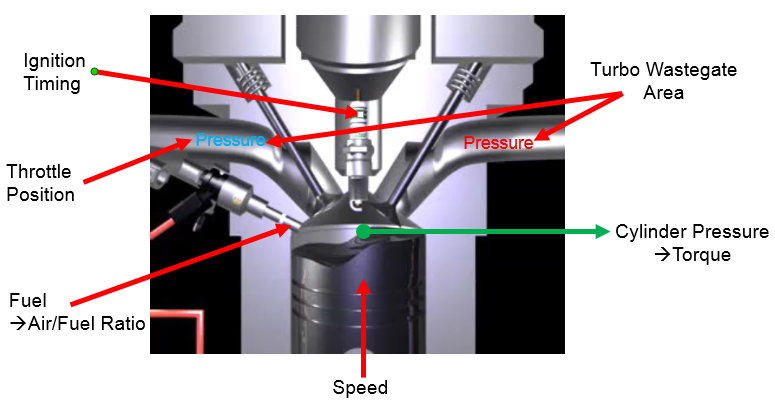
The engine to calibrate is a direct-injected 1.5L spark ignition (SI) turbocharged engine with dual-independent variable cam-phasers and turbocharger wastegate.
The aim of the calibration is to maximize torque at specific speed/load values across the engine's operating range, and meet these constraints:
Limit knock
Limit residual fraction
Limit exhaust temperature
Limit calibration table gradients for smoothness.
The analysis must produce optimal engine calibration tables in speed and load for:
Spark advance ignition timing (SA)
Throttle position % (TPP)
Turbo wastegate area % (WAP)
Air/Fuel Ratio (Lambda: LAM)
Intake cam phase (ICP)
Exhaust cam phase (ECP)
Torque (TQ)
Brake-specific fuel consumption (BSFC)
Boost (MAP)
Exhaust temperature (TEXH)
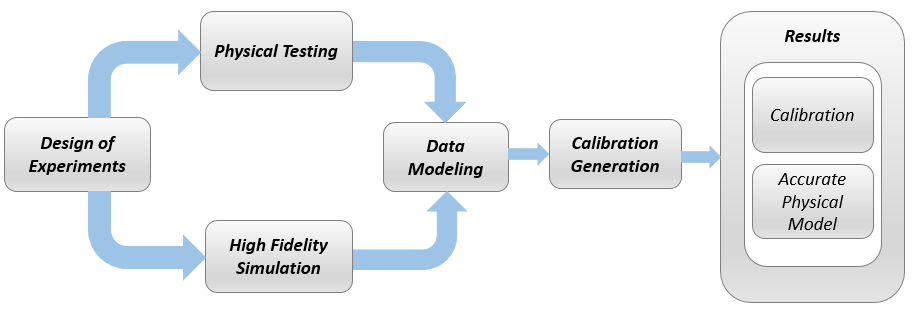
This case study illustrates the model-based calibration process.
Case Study Example Files
The following sections guide you through opening example files to view each stage of the model-based calibration process. You can examine:
Designs, constraints, boundary model, and collected data, in topic Design Experiments for Spark Ignition Engine Models.
Finished statistical models, in topic Fit Empirical Models to Spark Ignition Engine Calibration Data.
Optimization setup and results, and filled calibration tables, in topic Optimize Spark Ignition Engine Calibration Using Statistical Models.
Use these example files to understand how to set up systematic calibrations for similar problems. For next steps, see Design Experiments for Spark Ignition Engine Models.
Tip
Learn how MathWorks® Consulting helps customers develop engine calibrations that optimally balance engine performance, fuel economy, and emissions requirements: see Optimal Engine Calibration.

