Uniform Sphere Sampling with Fibonacci Lattice
R2026bThis example shows how to obtain uniform sampling along the surface of a unit sphere using a Fibonacci lattice.
Create and plot a unit sphere. The sphere function creates a uniform sampling along a grid in spherical coordinates. This sampling in Cartesian coordinates is not uniform.
figure
sphere
axis equal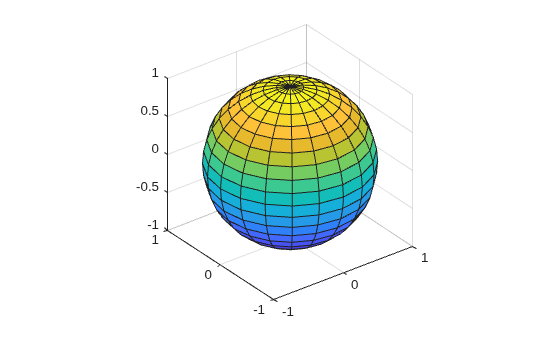
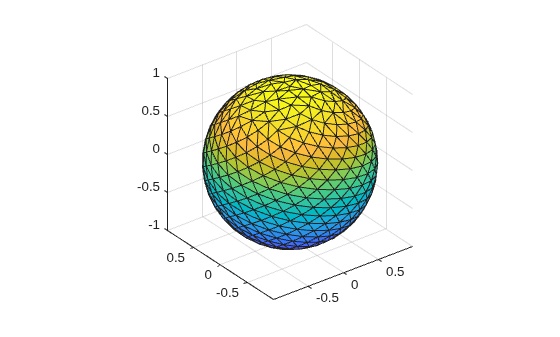
To obtain a uniform sampling in Cartesian coordinates, first generate a Fibonacci lattice of 500 points on a unit sphere.
n = 500;
indices = (0:n)';
The Fibonacci lattice provides uniform point distribution by spacing points along a spiral using the golden ratio.
goldenRatio = (1 + sqrt(5))/2;
Compute polar angle mapping points uniformly along the z-axis from 1 to -1.
phi = acos(1 - 2*indices/n);
Compute azimuthal angle using the golden ratio spacing.
theta = 2*pi*indices/goldenRatio;
Convert spherical coordinates to Cartesian coordinates.
x = sin(phi).*cos(theta);
y = sin(phi).*sin(theta);
z = cos(phi);
Compute the convex hull of the set of points on the sphere.
k = convhull(x,y,z);
Plot the result.
figure
trisurf(k,x,y,z);
axis equal